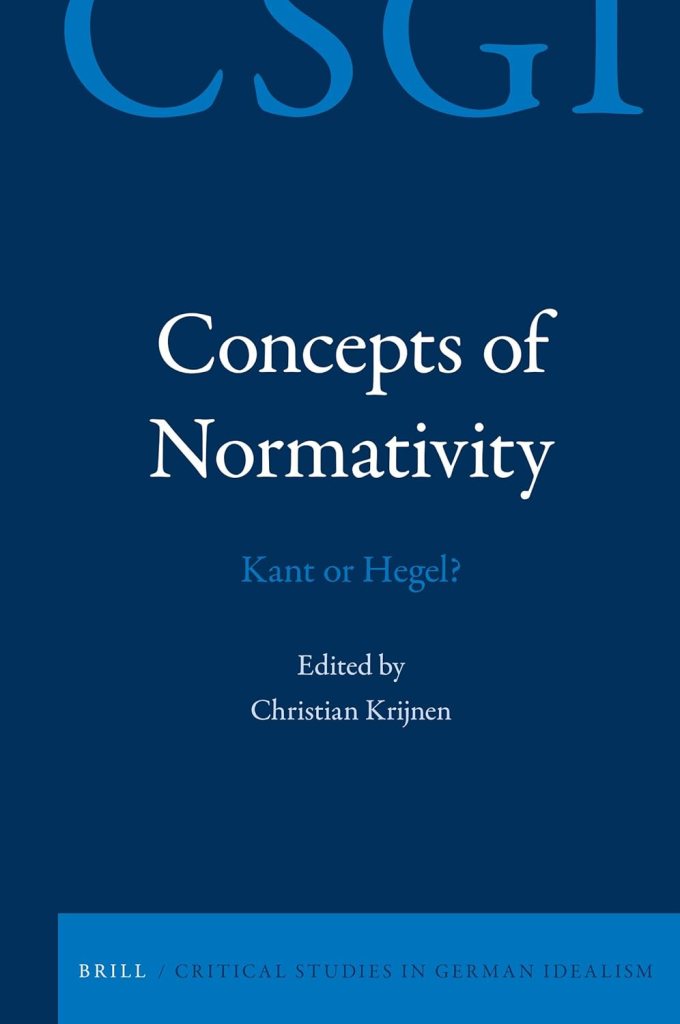
In the contemporary landscape of philosophical inquiry, the problem of normativity, as it manifests in moral and ethical theory, remains a central and contentious issue. Christian Krijnen’s Concepts of Normativity: Kant or Hegel? endeavours to illuminate this ongoing debate by juxtaposing the normative frameworks of two monumental figures in philosophy: Immanuel Kant and Georg Wilhelm Friedrich Hegel. The text is an examination of how these thinkers approach the concept of normativity, each from their unique vantage points, and how their respective theories have influenced subsequent scholarship.
Kant’s influence on modern value theory is profound and undeniable. His formulation of the Categorical Imperative, which insists on universality and the necessity of acting according to maxims that could be willed as a universal law, has shaped much of contemporary moral philosophy. Kant’s moral theory is fundamentally grounded in a formalist conception of normativity, where moral principles are derived from rationality itself, independent of empirical considerations. In contrast, Hegel’s critique of Kant’s formalism reveals a deeper, more integrated approach to understanding normativity, emphasizing the role of concrete social and historical contexts in the formation of ethical principles.
Hegel’s criticism of Kant’s model of normativity as overly formal and detached from actual human experience is central to the volume. Hegel challenges the Kantian notion of morality as an abstract set of principles by arguing that true ethical life (Sittlichkeit) cannot be fully comprehended without considering the embeddedness of the individual within a community and the dynamic, evolving nature of social institutions. For Hegel, ethical life is realized through a dialectical process wherein the subjective will finds its realization within the objective institutions of family, civil society, and the state.
The volume begins with Christian Hoffman’s exploration of Hegel’s philosophy of freedom and Bildung. Hoffman argues that Hegel’s conception of ethical life involves a holistic process where education and the development of the self are deeply intertwined with the realization of freedom within a community. Unlike Kant, who maintains a dualistic approach to reason and freedom, Hegel seeks to overcome this dichotomy through a monistic and holistic account. Hoffman’s analysis elucidates how Hegel’s approach integrates individual freedom with collective norms, highlighting a shift from Kant’s formalist perspective to a more relational understanding of ethical life.
Paul Cobben further expands on this theme by examining how Hegel radicalizes Kant’s Copernican turn. Cobben critiques Kant’s resolution of the Humean problem of impressions and categories, suggesting that Hegel’s approach offers a more unified account of natural and moral laws. Cobben’s analysis reveals that while Kant attempts to resolve the issue through a formal apparatus of categories and imagination, Hegel advances this discussion by demonstrating the limitations of Kantian formalism and offering a more integrated understanding of truth and moral development.
Arthur Kok’s contribution delves into Hegel’s account of religion, particularly Christianity, and its relation to Kant’s notion of moral law. Kok argues that Hegel’s conception of revealed religion represents a dialectical resolution of the tensions within Kantian ethics. By situating the divine within the community and emphasizing the incarnation as the manifestation of the divine within human experience, Hegel provides a more integrated account of moral value that transcends Kant’s abstract lawgiver.
Martin Bunte critiques Kant’s ethics from a formalism perspective, arguing that Kant’s moral laws are self-referential and tautological. Bunte’s article addresses the problem of how practical reason can generate laws that are both self-legislated and universally applicable. While acknowledging the validity of Hegel’s critique, Bunte contends that Kant’s approach still offers valuable insights into the nature of moral autonomy and the role of reason in ethical deliberation.
Max Gottschlich presents a comparative analysis of formal, transcendental, and dialectical logic in relation to normativity. Gottschlich argues that Kantian transcendental logic, while more adept than formal logic at addressing the paradoxes of determiners and determined, still falls short compared to Hegel’s dialectical logic. Hegel’s approach, which accepts contradiction as a dynamic aspect of self-realization, is portrayed as offering a more nuanced account of normativity that accounts for the development and actualization of ethical norms.
Klaus Vieweg’s German-language contribution focuses on the role of civil society within Hegel’s system of Ethical Life. Vieweg argues that civil society plays a crucial role in bridging the gap between abstract right and the concrete realization of freedom within the state. His analysis highlights the significance of civil society in Hegel’s philosophy and its often-overlooked role in the development of ethical norms.
Christian Krijnen’s own article addresses the tension between Kantian and Hegelian approaches to practical philosophy. Krijnen argues that while Kant provides a foundational understanding of normativity through formal principles, Hegel’s approach, which emphasizes the integration of practical philosophy into the concept of free Spirit, offers a more comprehensive account. However, Krijnen also critiques Hegel’s speculative approach for failing to engage with practical philosophy in a meaningful way, suggesting that it sublates practical concerns into a broader metaphysical framework.
Giulia Battistoni’s technical analysis of Hegel’s theory of imputation in the realm of Morality explores the challenges of deriving concrete duties from formal principles. Battistoni’s discussion of imputation in relation to Hegel’s critique of Kant highlights the complexities of attributing moral responsibility and the interplay between subjective intentions and objective norms.
Christian Schmidt’s article defends Hegel against contemporary critiques, particularly those of Louis Althusser. Schmidt contrasts Hegel’s synthesis of empirical and essential dimensions with Kant’s more abstract approach, arguing that Hegel’s conception of freedom as a synthesis of spontaneity and social norms provides a more integrated account of moral agency.
Jiří Chotaš contrasts Kant’s and Hegel’s justifications of the state, highlighting how Kant’s account of a social contract differs from Hegel’s more nuanced view of the state as the realization of ethical life. Chotaš’s analysis emphasizes the developmental nature of Hegel’s political philosophy and its implications for understanding state legitimacy and the realization of freedom.
Benno Zabel’s examination of Hegel’s penal philosophy focuses on its republican nature and its role in maintaining social order. Zabel’s analysis of punishment as a means of restoring freedom and communicating normative values provides insight into Hegel’s views on justice and its role within the ethical community.
Tereza Matějčková’s article contrasts Enlightenment and Hegelian conceptions of freedom, arguing that Hegel’s philosophy provides a more dynamic and integrated account of historical development and the realization of freedom. Matějčková’s discussion of Hegel’s view of history as the progress of the consciousness of freedom underscores the transformative potential of human agency within historical contexts.
Jean-François Kervégan’s analysis of the philosophy of history in Kant and Hegel argues that Hegel’s dialectical approach provides a more robust framework for understanding the historical development of Spirit. Kervégan critiques Kant’s historical writings for their lack of systematic philosophical analysis and contrasts them with Hegel’s integration of history into his philosophical system.
Alberto L. Siani explores the relationship between Hegel’s concept of freedom and European institutions, arguing that Hegel’s insights into freedom and ethical life are deeply intertwined with the development of European political and social structures. Siani’s analysis highlights the relevance of Hegel’s philosophy for understanding the nature of freedom in modern contexts.
Concepts of Normativity offers a rich and nuanced exploration of the normative theories of Kant and Hegel, providing a comprehensive overview of contemporary scholarly debates. Through detailed analyses of various aspects of Kantian and Hegelian thought, the volume sheds light on the ongoing relevance of these philosophers’ ideas in understanding the nature of normativity, ethics, and the development of moral principles.
 Simon Gros
Leave a comment