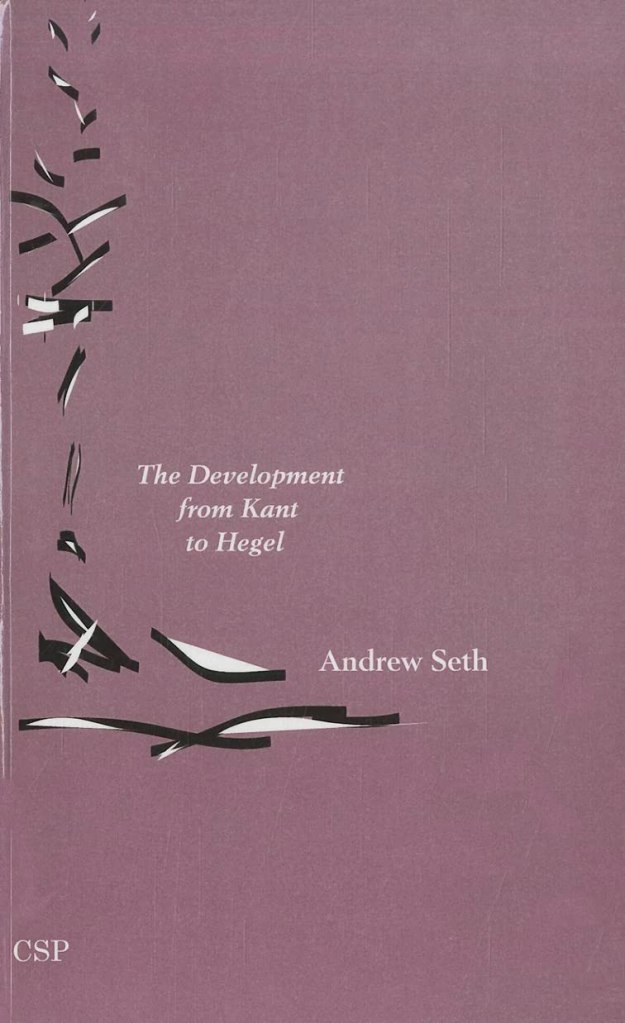
Andrew Seth’s The Development from Kant to Hegel stands as a key contribution to the study of German philosophy, especially within the English-speaking academic world. This scholarly work, written during Seth’s tenure as a Hibbert Travelling Scholar in the summer of 1880, offers a rich exposition of the evolution of philosophical thought from Immanuel Kant to Georg Wilhelm Friedrich Hegel. Seth’s analysis, subsequently expanded into a comprehensive study of the philosophy of religion, has played a critical role in shaping the understanding of German Idealism and its impact on modern philosophical inquiry.
Seth’s examination of Kant serves as the foundation for his philosophical investigation, laying the groundwork for understanding the subsequent transformations in German thought. Kant’s critical philosophy, with its rigorous approach to epistemology and metaphysics, marks a departure from previous philosophical traditions. His focus on the conditions necessary for the possibility of experience and knowledge initiated a shift in philosophical understanding. Seth engages with Kant’s critical framework, addressing the core results of Kant’s investigations and their implications for the development of subsequent philosophical systems. While acknowledging the extensive scholarly work on Kant, Seth opts for a focused analysis that highlights Kant’s seminal contributions and identifies the limitations that set the stage for the philosophical advancements of his successors.
Transitioning from Kant to Fichte, Seth illuminates the radical shift that Fichte’s Idealism represents. Fichte’s philosophy is presented as a systematic development and transformation of Kantian thought. By identifying a central principle of Idealism in Kant’s work, Fichte sought to unify and extend Kant’s fragmented insights into a coherent and comprehensive philosophical system. Seth’s detailed examination of Fichte’s metaphysical theories reveals how Fichte’s approach diverges from Kant’s by emphasizing the role of the self or Ego as the foundational principle of reality. This exploration provides a deep understanding of how Fichte reconfigures Kantian thought to establish a new philosophical paradigm, while also critiquing the inherent weaknesses and challenges within Fichte’s system.
Schelling’s contributions are analysed in the context of his critique of Fichte and his broader philosophical ambitions. Schelling’s Naturphilosophie, with its emphasis on reconciling nature and intelligence, represents a significant evolution in German Idealism. Seth explores how Schelling’s philosophy addresses the perceived subjectivity and limitations of Fichte’s Idealism by integrating nature into the philosophical system as an essential and intelligible component of reality. Schelling’s attempt to account for nature as a process of intelligence, rather than merely as an external obstacle to self-realization, marks a critical development in the philosophical discourse. Seth’s detailed treatment of Schelling’s work sheds light on the complex dynamic between nature, consciousness, and the Absolute, highlighting the philosophical advancements that Schelling introduces.
The culmination of Seth’s study is his analysis of Hegel’s philosophy, which represents the zenith of the German Idealist movement. Hegel’s dialectical method and his conceptualization of the Absolute as Spirit reflect a pinnacle of the ideas developed by his predecessors. Seth’s examination of Hegel reveals how Hegel’s system integrates and transcends the contributions of Kant, Fichte, and Schelling, culminating in a comprehensive philosophical framework that seeks to reconcile diverse elements of human experience and thought. Hegel’s philosophy, with its intricate dialectical process and its focus on the development of Spirit, represents a culmination of the idealist tradition, aiming to provide a complete account of reality and its processes.
Throughout The Development from Kant to Hegel, Seth’s analysis traces the intellectual lineage of German Idealism and offers a critical perspective on the philosophical developments that shape this tradition. By providing a thorough examination of the core metaphysical positions of Kant, Fichte, Schelling, and Hegel, Seth’s work contributes significantly to the understanding of how these philosophers’ ideas evolved and influenced the subsequent trajectory of philosophical thought. This work remains an invaluable resource for scholars and students of philosophy, offering insights into the foundational developments of modern philosophy and the evolution of metaphysics.
 Simon Gros
Leave a comment