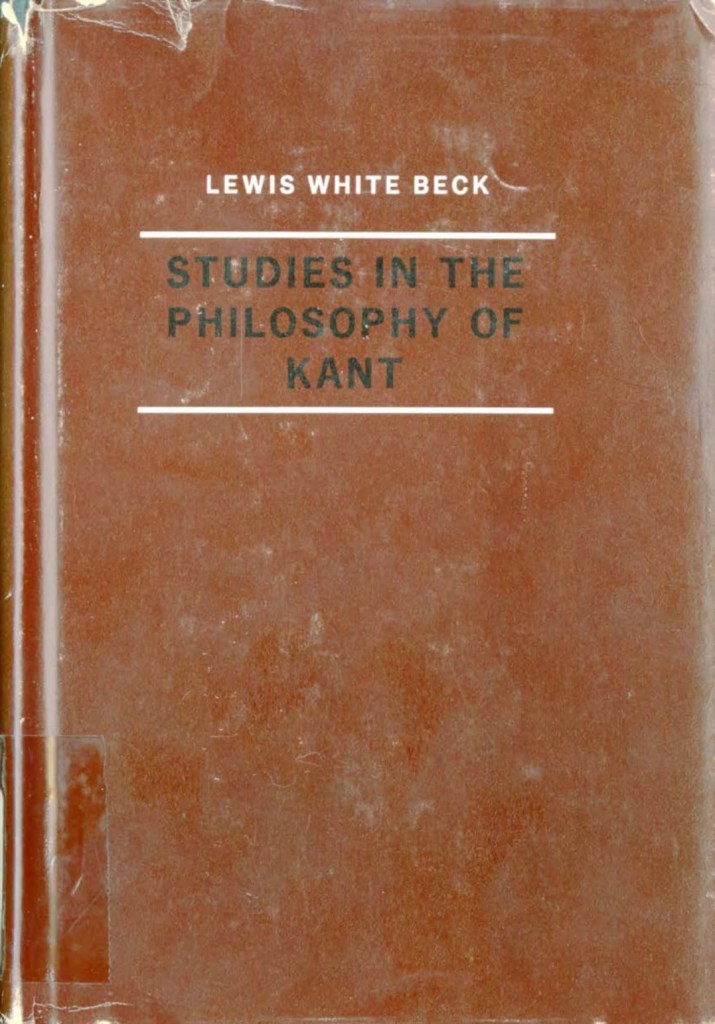
Lewis White Beck’s Studies in the Philosophy of Kant is a testament to the depth and scholarly acumen that Beck, a preeminent philosopher and Kant specialist, brought to his rigorous exploration of Immanuel Kant’s oeuvre. Published in 1965, this collection of Beck’s essays represents his scholarly engagement with Kantian thought, reflecting Beck’s dual role as a translator and interpreter of Kant’s complex ideas. Beck, whose academic career spanned several decades at the University of Rochester, brought about a specific approach to Kant’s philosophy.
Beck’s analysis is an examination and a critical reinterpretation of Kant’s theoretical and practical philosophies, which he explains with both precision and a a clear understanding of the historical and philosophical context. Beck begins by addressing the fundamental issue of how Kant’s philosophy tackles the logical incompatibility between objective and subjective conditions of knowledge. This problem, which has persisted as a central concern in modern thought, is approached through an examination of Kant’s assertion that human knowledge and the natural world are inextricably linked yet fundamentally discordant.
One of the primary themes in Beck’s essays is the exploration of Kant’s theory of synthetic a priori judgments. Beck analyses the complexities of how such judgments are possible, exploring the implications of Kant’s assertion that certain knowledge claims extend beyond empirical experience while remaining universally valid. This issue is central to understanding Kant’s critique of pure reason and his broader philosophical project, which aims to reconcile the empiricist and rationalist traditions. Beck’s examination extends to the meta-semantics of the synthetic a priori, where he evaluates the distinctions between analytic and synthetic judgments. His analysis reveals the ways in which Kant’s work challenges traditional notions of knowledge and its foundation.
The volume also features critical engagements with critics of Kant. Beck responds to those posed by Nicolai Hartmann and Henry Margenau, addressing their interpretations and challenges to Kant’s theories. Another notable aspect of Beck’s work is his discussion of the ethical dimensions of Kant’s philosophy. His essays on Kant’s moral philosophy, including the Critique of Practical Reason and the Foundations of the Metaphysics of Morals, explore the development and implications of Kant’s ethics. Beck examines the transition from Kant’s theoretical framework to his practical philosophy, elucidating the ways in which Kant’s concepts of duty and moral law are grounded in his broader philosophical system.
In addition to his analysis of Kant’s own work, Beck reflects on his own position within the Kantian tradition, as evidenced by the essay Lewis’ Kantianism. This introspective piece provides insight into Beck’s philosophical orientation and his contributions to Kantian thought, demonstrating how his interpretations align with or diverge from traditional readings of Kant.
Beck’s Studies in the Philosophy of Kant is further enriched by the inclusion of translated materials, such as Kant’s letter to Marcus Herz, which offers a glimpse into Kant’s correspondence and personal reflections. This addition not only provides historical context but also enhances the reader’s understanding of Kant’s philosophical development.
The volume concludes with a rigorous examination of Kant’s conceptions of the will within their political context. Beck’s analysis here reflects his broader commitment to analysing the implications of Kant’s philosophy for understanding human agency and ethical behaviour.
Studies in the Philosophy of Kant is a work that encapsulates the complexity of Kantian philosophy through a series of critical essays. Beck’s scholarship is characterized by a deep engagement with Kant’s texts, and a thoughtful response to critiques. His contributions to Kantian studies are evident throughout this volume, making it an essential resource for scholars and students of philosophy alike.
 Simon Gros
Leave a comment