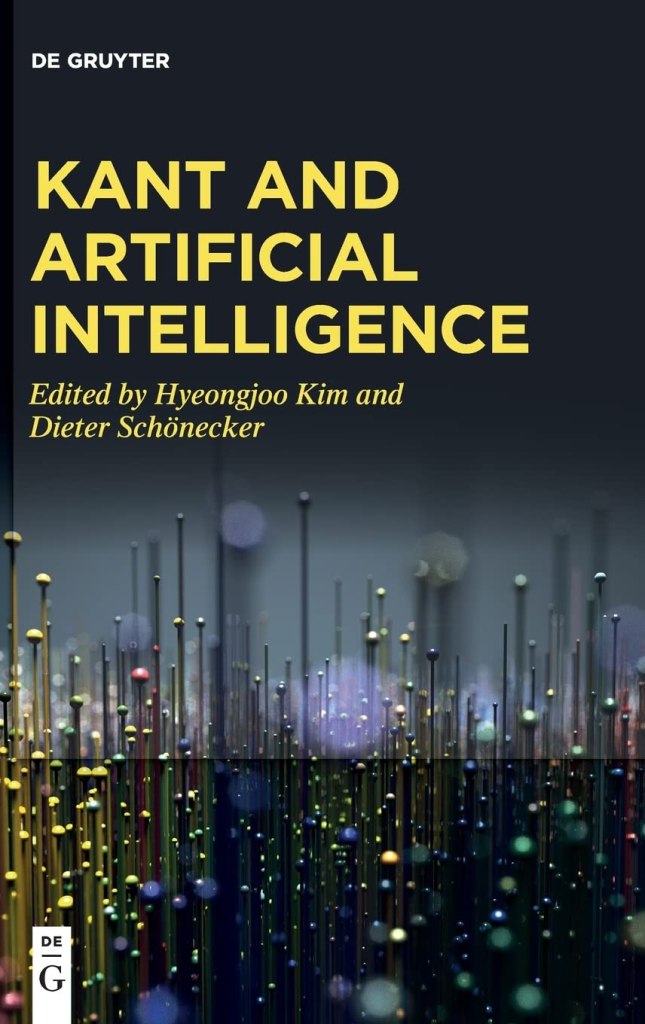
Kant and Artificial Intelligence, edited by Hyeongjoo Kim and Dieter Schönecker, presents the relationship between Immanuel Kant’s philosophical principles and the rapidly evolving domain of artificial intelligence (AI). This volume is a sophisticated overview of how Kantian thought can both elucidate and be challenged by contemporary AI advancements, offering a comprehensive philosophical analysis that addresses the nature of cognition, self-consciousness, ethics, and aesthetics through the lens of AI.
The central inquiry of the book revolves around two pivotal questions: how can the strong claims made by AI and its proponents be understood and evaluated from a Kantian perspective, and conversely, what insights can AI’s development provide into the validity and applicability of Kantian philosophy? This dual approach offers a rich terrain for philosophical investigation, allowing for a critical dialogue between classical and modern thought.
Kant’s influence on cognitive science and AI is significant, as his theories about the nature of cognition, understanding, and self-consciousness resonate with contemporary debates. The book engages deeply with Kant’s concept of cognition, particularly his ideas on apperception and the unity of consciousness. It scrutinizes whether AI systems, with their advanced learning algorithms and deep neural networks, can achieve forms of self-consciousness and intentionality comparable to human cognition. The philosophical discussion extends to whether Kant’s notions of the self and experience can be meaningfully applied to AI, or whether AI challenges these notions in new and unforeseen ways.
A key area of exploration is the application of Kant’s theoretical philosophy to the realm of AI, particularly how his ideas about the mind and cognition relate to modern cognitive science paradigms such as functionalism, enactivism, and predictive processing. The book investigates whether AI’s approach to problem-solving, learning, and perception can be reconciled with or challenged by Kantian theories. This includes a critical examination of whether AI systems, through their computational and representational processes, align with or diverge from Kantian notions of mental representations and cognitive functions.
The volume also addresses ethical considerations from a Kantian perspective, questioning the moral status of AI and its implications for ethical theory. It explores whether AI can be considered a moral agent, capable of making ethical decisions in a manner consistent with Kantian ethics. This includes discussions on whether AI systems can possess moral feelings or practical reason as Kant conceived them, and what this means for the ethical programming and deployment of autonomous systems.
Furthermore, the book examines the legal and social implications of AI through a Kantian lens. It investigates whether AI systems can be integrated into legal and social frameworks in a way that respects Kantian principles of autonomy and rights. This includes exploring the role of AI in making decisions that affect human lives, such as in autonomous driving scenarios, and how Kantian ethics can inform the development of AI policies and regulations.
In the realm of aesthetics, the volume considers Kant’s theories of beauty and subjective experience in relation to AI’s capabilities. It explores whether AI can engage with or contribute to aesthetic judgments and the experience of beauty in a manner that aligns with or challenges Kantian aesthetics. This includes a discussion of whether AI-generated art or AI’s capacity to process and interpret aesthetic experiences can be understood through Kant’s notions of the beautiful and the sublime.
Overall, Kant and Artificial Intelligence offers a multifaceted examination of the intersections between Kantian philosophy and AI. It provides a detailed analysis of how Kant’s ideas about the self, cognition, ethics, and aesthetics can be applied to contemporary AI developments, and how AI’s capabilities and limitations might provide new insights into Kantian thought. By bridging the gap between historical philosophical concepts and cutting-edge technological advancements, the volume contributes to a deeper understanding of both Kantian philosophy and the philosophical implications of artificial intelligence.
 Simon Gros
Leave a comment