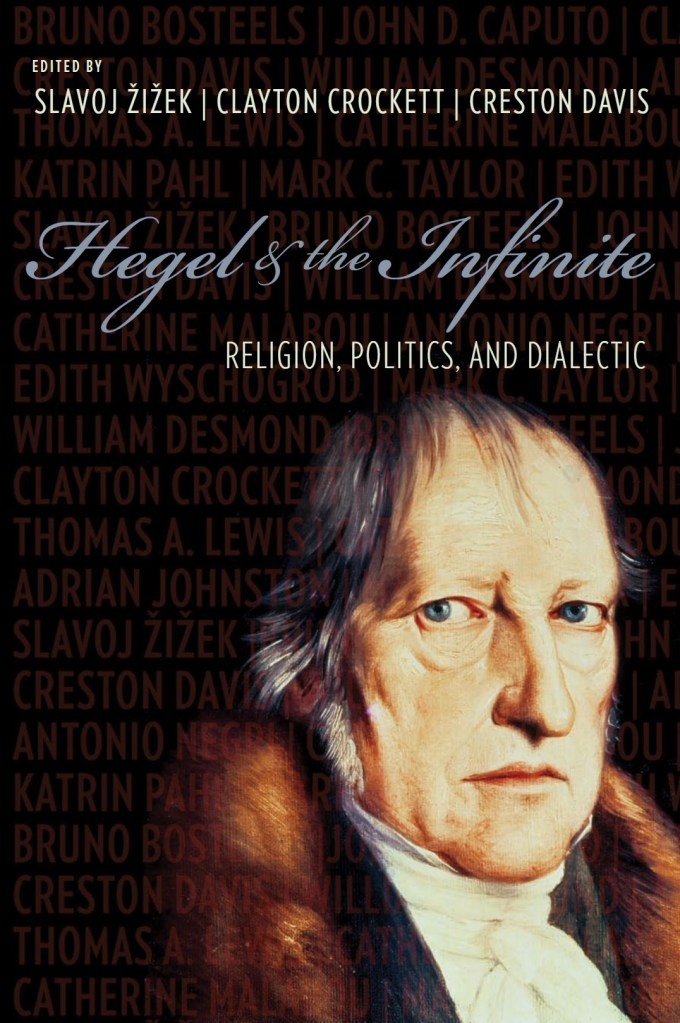
Hegel and the Infinite, edited by Slavoj Žižek, is an ambitious exploration of the enduring relevance of Hegel’s thought in contemporary philosophy, politics, and religion. This volume brings together a diverse array of prominent thinkers, including Catherine Malabou, Antonio Negri, John D. Caputo, Bruno Bosteels, Mark C. Taylor, and Žižek himself, alongside others, to engage with Hegel’s ideas in ways that push beyond conventional interpretations and challenge the boundaries of modern thought.
At the heart of this collection is a shared commitment to safeguarding Hegel’s legacy from claims of irrelevance and obsolescence. The contributors argue against the notion that the evolution of thought and history has reached an endpoint, contending instead that Hegel’s dialectical method remains a powerful tool for understanding and transforming the complexities of the twenty-first century. The volume thus reclaims Hegel as a philosopher whose innovations are not only historically significant but are also crucial for navigating the intellectual and political challenges of our time.
The essays in this collection collectively illuminate how Hegel’s philosophy continues to resonate within contemporary discourse, particularly at the intersection of the secular and the sacred. By revisiting Hegel’s dialectic, the contributors engage with the philosopher’s notions of absolute knowledge, recognition, and the infinite. They explore how these concepts bear on current debates surrounding religion, politics, and the nature of reality itself. The contributors draw on a wide range of Hegel’s works, from his early writings to his mature system, demonstrating the ongoing relevance of his thought across different domains.
Žižek and his co-editors argue that Hegelian dialectics remain a critical litmus test for philosophical inquiry today. By challenging the reductive readings of Hegel that have emerged in the wake of postmodernism and the critiques of thinkers like Levinas, Derrida, and Deleuze, this volume seeks to uncover the radical potential of Hegel’s thought. It positions Hegel not as a totalizing thinker who suppresses difference, but as a philosopher who confronts and incorporates difference into the very structure of thought itself. The essays advance the idea that Hegel’s philosophy, far from being an obsolete relic, is a vital, dynamic force that offers key insights into the dialectical nature of reality and the interplay between the finite and the infinite.
The volume’s contributions traverse a wide spectrum of philosophical disciplines, including theology, political theory, art, literature, and science, reflecting Hegel’s own interdisciplinary approach. The authors engage deeply with Hegelian concepts such as the master-slave dialectic, the end of history, and the idea of absolute spirit, applying them to contemporary issues like global capitalism, identity politics, and the resurgence of religious fundamentalism. In doing so, they not only reaffirm Hegel’s relevance but also propose new ways of thinking about the possibilities and limits of dialectical thought.
One of the central themes of the book is the re-examination of the relationship between the secular and the sacred in Hegel’s philosophy. The contributors argue that Hegel’s thought offers a unique perspective on the tension between these two realms, particularly in the context of the modern “return to religion.” By exploring how Hegel’s concept of the infinite intersects with notions of divine transcendence and human finitude, the essays in this collection provide a nuanced understanding of the role of religion in contemporary society. They show how Hegel’s dialectic can be used to rethink the boundaries between the sacred and the secular, offering a more integrated and holistic view of reality.
Hegel and the Infinite also addresses the political implications of Hegel’s philosophy, particularly in relation to questions of freedom, recognition, and the state. The contributors critically engage with Hegel’s philosophy of right, his views on civil society, and his understanding of political emancipation, offering new interpretations that challenge both conservative and radical readings of his work. By doing so, they highlight the transformative potential of Hegel’s thought for contemporary political theory, suggesting that Hegel’s dialectical method can help us navigate the complexities of modern political life and the challenges posed by global capitalism, social inequality, and cultural fragmentation.
Hegel and the Infinite is a rigorous and intellectually demanding work that invites readers to engage with Hegel’s philosophy in new and provocative ways. The volume not only reaffirms Hegel’s place in the pantheon of great philosophers but also demonstrates the enduring power of his ideas to illuminate the most pressing issues of our time. By bringing together a diverse group of scholars who are committed to rethinking the possibilities of dialectical thought, this book offers a rich and multifaceted exploration of Hegel’s legacy and its relevance for the twenty-first century. Whether one is a seasoned Hegel scholar or a newcomer to his thought, Hegel and the Infinite provides a compelling and thought-provoking engagement with one of the most challenging and influential philosophers in the history of Western thought.
 Simon Gros
Leave a comment