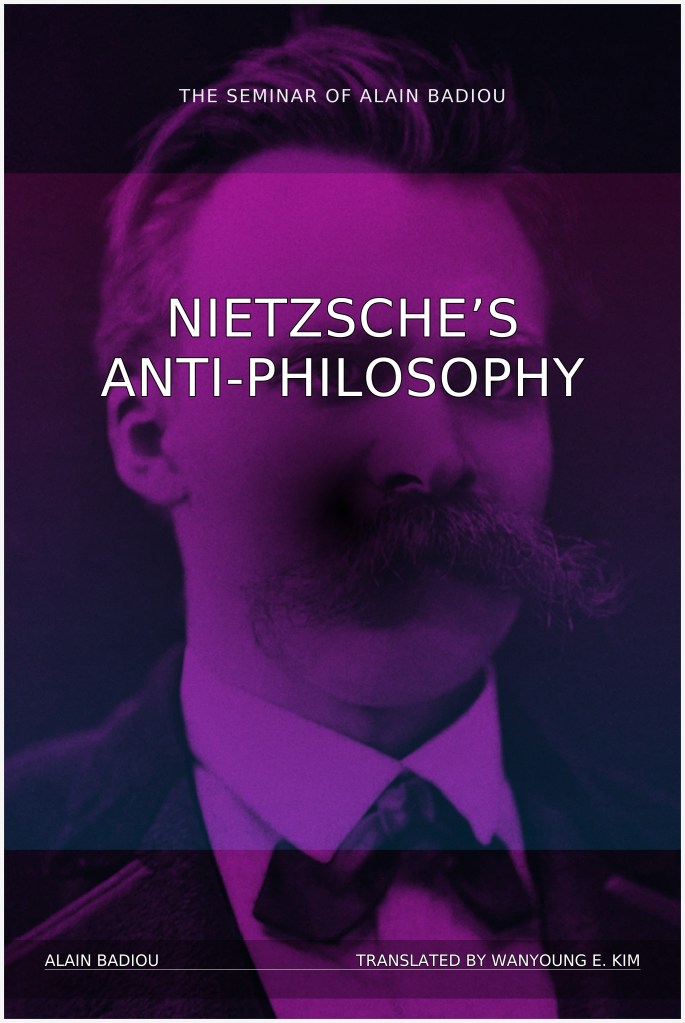
The Seminar of Alain Badiou: Nietzsche’s Anti-Philosophy, translated and edited by Wanyoung E. Kim from notes by Aimé Thiault and a transcription by François Duvert, gathers the 1992–1993 Paris seminar in which Alain Badiou made Nietzsche the inaugural figure of a larger itinerary through what he calls antiphilosophy—a name for those discourses that, while philosophically decisive, pressure philosophy at its limit by replacing argument with a performative, risk-laden declaration of value. The result is both a lucid map of Badiou’s own system in formation and a rigorously staged encounter with Nietzsche’s singular mode of thinking, presented here with the translator’s careful apparatus situating aims and choices.
Badiou begins by clarifying the three linked lines of analysis that organize the whole: a topical interrogation of the status of “the Nietzschean text” (from where and as what does it speak?), a historical interrogation of the twentieth century’s Nietzschean inflection or inheritance, and a generic interrogation of philosophy’s relation to art in light of Nietzsche’s philosopher-artist paradigm. These three strands—textual status, epochal influence, and the art–philosophy nexus—are not merely juxtaposed; they form the seminar’s method for reading a corpus that resists standard protocols of commentary. From the first session, Badiou insists that Nietzsche’s writing oscillates between destructive pamphleteering and Dionysian affirmation without passing through the mediations of dialectical proof, and that this formal disposition compels the reader to adopt a different “protocol of use” of the text altogether.
That protocol turns on a redefinition of truth. For Badiou’s Nietzsche, truth is not a conclusion certified by evidence but a decision borne by a subject who speaks in his own name, accepts the risk of the utterance, and endures the terrible weight of what is said. Hence the characteristic formulations Badiou dwells upon—truth as decision (“I am the first who can decide”), the subject as vector of a dose of truth he can or cannot bear, and the insistence that genuine saying abolishes the gap between who says and what is said. As Badiou reconstructs it, Nietzsche makes truth coincide with the act of enunciation as such; argument’s “compulsion” gives way to an evaluative power that exposes itself. In this light, the most emphatic and “mad” sentences are not symptoms to be explained away; they are structural conditions for the text’s possibility. They mark the point where the subject binds himself to a declaration without external guarantor, embracing risk and measure by the criterion of endurance rather than demonstration.
Because of this performative conception, Badiou presents Nietzsche not as the originator of a doctrine but as the name of an breaking event in language. This event is the discovery—recognized even by “anyone,” as Nietzsche’s Turin vignette about the Market of Four Seasons imagines—that language can do what it could not do before, that it can sustain a subject who refuses to differentiate between the “I” who speaks and what is spoken. Hence Badiou lingers over Nietzsche’s striking line to his mother in December 1888—“There is no name that is now pronounced with more consideration or respect than mine… No name, no title, no money…”—to dramatize the paradox of an “anonymous” name whose authority is neither social title nor doctrinal pedigree but the naked exposure of a subject to truth as decision. The “princely” recognition in the marketplace is the generic sign that a truth declared can be legible without institutional mediation: an antiphilosophical criterion of philosophical recognition.
From this vantage point Badiou situates Nietzsche between his two great reconstructions, Heidegger’s and Deleuze’s, whose maximal deviation he will exploit to triangulate his own position. Heidegger’s multi-volume Nietzsche is treated as a sustained effort to measure the “eventality” of Nietzsche’s rupture against the history of Being; Deleuze’s Nietzsche et la philosophie is treated as the counter-move that radicalizes affirmation and interpretation against reactive negation. Badiou neither simply sides with one nor balances them eclectically; he uses their opposition to frame the problem of whether Nietzsche’s gesture truly constitutes an event for thought or remains caught in the reactive capture it seeks to overcome. That question propels the seminar’s architecture beyond reception history: it fixes the angle from which Badiou evokes Nietzsche’s implicit ontology and the condition of art within his philosophy.
The seminar’s middle movement delivers Badiou’s compact “Nietzschean ontology” as six propositions. The first two orient everything that follows: (1) what there is—the il y a—is named Becoming or life; these names, as names, mark the indeterminacy of what is, not a meaning imposed upon it; (2) Being—as a substantive—is a bad, even fictitious designation of the il y a; indeed one ought not name the il y a as Being at all. In Badiou’s reading, Nietzschean naming does not confer sense but interrupts sense with an evaluative “yes” to the plurality of becoming; correlatively, the retrospective naming of what there is as Being appears as a reactive interdiction against this yes. The polemic goes all the way back to Parmenides and Heraclitus: philosophy (Parmenides) institutes ontological depreciation by naming the il y a as Being; antiphilosophy (Heraclitus) preserves affirmation by naming it as becoming or fire. The choice of the name is already a choice of regimen for thought.
Around these two leading claims Badiou assembles the remaining Nietzschean theses as he sees them, while simultaneously staging his own philosophical counter-propositions. Precisely where Nietzschean antiphilosophy depreciates logic (and with it mathematics) as the abstract machine of reactive stabilization, Badiou will counter by recentering logic (as traced from mathematics) in philosophy. Precisely where Nietzsche tends to absolutize relation (“there are nothing but relations”), Badiou’s ontology of pure multiplicity insists that “since there is pure multiplicity, there is no relation.” What matters in the seminar is not a scholastic tally of who is right but the demonstration that Nietzsche’s antiphilosophical naming of what there is, his suspicion of logical fixity, and his appeal to artistic drama as a philosophical resource together compose a coherent stance—a stance Badiou both acknowledges (as event) and contests (as philosophy).
This dual movement—acknowledgment of the event and contestation of its consequences—comes to a head where Badiou connects Nietzsche’s thinking to arch-politics: the political thought that precedes the state and asks whether a generic human essence could be ordered under the theme of non-statist sovereignty. Reading Nietzsche’s Übermensch as the subjective name of such a possibility (divorced from later ideological perversions), Badiou juxtaposes it to the nineteenth-century’s generic name “communism” (again, not in the twentieth-century state form), arguing that the century tested whether humanity could be conceived as a form of sovereignty that de-statizes itself. In the same register, Badiou reconstructs Nietzsche’s five theses on “the State, the new idol”—the disjunction of people and state, the correlative “death of God/death of the State,” the corruption proper to state form, the state’s transmutation of art, science, and philosophy into cultural magma, and the insistence that humanity is always beyond the state. What links these theses to the ontology is their shared wager: only an affirmation that refuses the reactive naming of Being can refuse the idol of the state.
The same logic governs Badiou’s treatment of Nietzsche’s “act.” Across a pivotal cluster of pages, Badiou weighs three influential construals of the Nietzschean act: first, as the creation of new values against reactive nihilism; second, as the promotion of maximal intensity; third, as the interpretive sovereignty as pointed towards by Foucault. He exposes what is gained and lost in each and then realigns the act with a poetic-dramatic necessity: the act is not a concept to be defined but a metamorphosis to be presented. For that reason the Zarathustran sequence of the three metamorphoses—camel, lion, child—becomes decisive. The problem is not the passage from burden-bearing to refusal (camel to lion) but the obscure leap from the lion’s negating force to the child’s creative innocence. The act lives, if it lives at all, in that leap beyond sovereignty as such, an “untethering” that no analysis can represent but that art can present as presence. The seminar thus binds Nietzsche’s anti-philosophical truth to the presentation of metamorphosis—as an aesthetic condition of philosophy rather than a mere illustration.
From here the generic dimension—philosophy’s relation to art—receives its most comprehensive articulation. Against the Romantic hypostasis of art as the locus of truth and against the purely didactic expulsion of art as dangerous semblance, Badiou identifies a “classical” disposition (Aristotle stands as emblem) in which art, as mimesis, remains neither sacred bearer of truth nor threat to philosophy’s vision. Nietzsche, however, compels a different alignment: because the Nietzschean truth is the risk of saying itself, philosophy requires an intense drama to register the act. In a later appendix, Badiou glosses Michel Deguy’s proposition “I owe you the truth in a poem” to show how the poem can be the immanent place of truth as address, not its external vehicle. In this sense, poetry and theater are not ornaments to philosophy but the condition for presenting what cannot be conceptually represented: the coincidence of subject and saying.
It follows that the seminar devotes sustained attention to naming, to the non-contradictory logic of against, and to the legalistic diction of the Anti-Christ as a juridical rhetoric beyond theology that prosecutes the “vice” of reactive morality. Here Badiou is careful to preserve the nuance between Nietzsche’s polemic against Christian hypocrisy and any crude rejection of the figure of Christ; the issue is the genealogy of valuations that weaponize being as a category against life, and the corresponding need to speak otherwise about the human. Even the rhetoric of law in The Anti-Christ is reinscribed as a formal index of the act’s claim to decide and to judge, not an appeal to transcendent authority. To that end, the seminar continually returns to proper names (“Dionysus,” “Zarathustra,” “Wagner”) as operators of an affirmative re-typing of the philosopher as artist—another mark of antiphilosophy’s departure from the priestly figure who hides behind universals.
Badiou’s most precise reconstructions of the philosophical basis turn on minute readings of the il y a, its naming, and the stakes of sense. If “life” is a name of what there is, it must be taken as a name, not as a donor of meaning; sense, here, is itself a kind of evaluation, and Nietzsche’s wager is to locate a yes anterior to the evaluative capture of meaning. Conversely, to name what there is “Being” is already to have installed a prohibition—a reactive interdiction of the yes—which is why Nietzsche’s anti-philosophy refuses any dialectical rescue by non-Being; contradictory pairs are not the right currency. The pairing of Parmenides/Heraclitus becomes, in Badiou’s hands, the originary fracture between philosophy and antiphilosophy—between a naming that depreciates the evental there is and a naming that affirms it.
That fracture has consequences also for mathematics and logic, which antiphilosophers tend to conflate as the paradigm of reactive stabilization. It also has consequences for relation: to say “there are nothing but relations” (an antiphilosophical temptation Badiou detects in Nietzsche) is, paradoxically, to miss how relation itself presupposes a prior decision about what counts as one (or as many). Badiou’s counter-thesis—pure multiplicity without relation—therefore functions less as a refutation of Nietzsche than as an internal delimitation: it states what must be presupposed if philosophy is to remain argumentative without surrendering the dramatic intensity that Nietzsche has shown to be necessary for truth’s presentation. In this sense, Badiou’s six “philosophical statements” mirror the six “Nietzschean propositions” to exhibit a structural dialogue between antiphilosophy and philosophy that neither side can complete alone.
The political corollary of this dialogue is clearest when the seminar turns to the state. Nietzsche’s five theses on the “new idol” are not meant as a political program but an arch-political diagnosis: wherever the state becomes the measure, culture collapses into magma, art and science are administered, and the people are severed from themselves. The path beyond the state is not chaos but a discipline of affirmation—a non-statist independence of the subject equal to the creative demands of truth. Badiou’s audacious rapprochement between the Übermensch and the nineteenth-century’s generic “communism” shows how the century tested, under two names, whether such a sovereignty is thinkable. The test failed in its statist instantiations but remains conceptually alive as a problem traced at the junction of philosophy and politics.
To draw the artistic and political threads together, Badiou repeatedly returns to Wagner. The appendix on “Wagner’s anti-philosophy” and the series of “new courses” on poetry, theater, Apollo and Dionysus, and Wagnerian art are not excursions but laboratories in which the seminar measures the limits of theatricalization, semblance, and dramatization. The point is not to aestheticize philosophy but to register that a thinking of the act must present itself—must find a scene or a song equal to its risk—if it is to avoid regressing to reactive representation. In the margins of this questioning Badiou offers contemporary touchstones (Rimbaud; Michel Deguy’s “I owe you the truth in a poem”) to name a vocation for the poem that is strictly immanent: the poem does not carry truth from elsewhere; it is the place where truth occurs as address.
Throughout, Kim’s translation does more than render French into English. The translator’s foreword explains crucial terminological decisions—above all, the choice to capture Macht (power) as puissance in order to guard against the historical misidentifications that equated Nietzsche’s “will to power” with mere Kraft (brute force). The foreword also clarifies shifts of vocabulary (e.g., régime as “order,” l’apparaître as “appearance”) so that the reader does not mishear Badiou’s distinctions in the theater/semblance/appearance field. Such choices matter because much of Badiou’s pedagogy in this seminar proceeds by delicate oppositions in naming: an errant synonym can collapse the difference between a reactive and an affirmative designation of the il y a.
If one asks, finally, what is most distinctive in Badiou’s reading of Nietzsche here, the answer is not any single thesis but the manner in which he stabilizes “antiphilosophy” as a concept by stabilizing its instability. The “anti-” is not the contrary of philosophy inside a dialectic but an alter-regime of address that forces philosophy to reconsider the means by which it names what there is, the terms under which it claims truth, and the forms it must borrow from art to present what cannot be argued without remainder. In the first two sessions especially, Badiou patiently demonstrates why the Nietzschean text is in a sense inapt for standard philosophical questioning: it exhibits rather than proposes; it is suffered rather than simply held; it is judged, if at all, by how it can be endured. To recognize that is not to capitulate to irrationalism (Badiou is explicit on this point) but to exchange the compulsions of proof for a criterion of value that answers to decision, risk, and measure.
The implications for our present are far from antiquarian. The seminar’s historical question—“to what extent was the century Nietzschean?”—turns out to be less a verdict than a diagnostic method: read our epoch by asking which names (Being, life, multiplicity) we let rule our speech, which forms (proof, song, drama) we deem adequate to truth’s arrival, which political forms (state, party, movement, event) we privilege when we imagine the common. Badiou’s own philosophical counter-statements—pure multiplicity, no relation; logic inscribed from mathematics; the double resource of adequate language and intense drama—do not cancel Nietzsche’s antiphilosophy; they take responsibility for what Nietzsche’s decision exposes: a philosophy that would remain equal to truth must learn, again, to speak in its own name while submitting itself to the artistic conditions without which the act is unpresentable. In that precise sense, Nietzsche’s Anti-Philosophy seminar is not a mere interpretation of Nietzsche; it is Badiou’s self-portrait as a philosopher who, facing the same dilemma, refuses both priestly authority and theatrical escapism, choosing instead to let mathematics and poetry, proof and song, coexist under the pressure of an event whose first demand is that one decide.
The book’s deepest achievement may lie in the clarity with which it shows that Nietzsche’s “anti-” does not mean sabotage of philosophy but the invention of a new responsibility for saying. To name the il y a “life” is to pledge a yes whose consequences must be borne at the level of the subject, the city, and the poem. To refuse “Being” as a name is to interrupt a millennial interdiction that fused philosophy with a ban on affirmation. To declare truth as decision is to bind one’s name to what is said, even to the point where the “mask of madness” is only the mask worn by a knowledge too sure of itself—too sure not because it possesses certainty but because it accepts the absence of external guarantors. The seminar keeps these threads interlinked: Heraclitus’ fire with Nietzsche’s life; the lion’s sovereignty with the child’s play; the new idol with the non-statist form; the poem’s address with philosophy’s argument. In doing so, it lets Nietzsche’s text “take place” again, not as a doctrine to be assented to or rejected but as an exposure to what language can do when it shoulders the destiny of a decision that no one else can make for us.
For readers of Nietzsche, the value here is not simply expository but diagnostic: Badiou exhibits how much of what is most contested in Nietzsche—his relation to art, his politics, his psychology, his supposed “irrationalism”—arises from mistaking the genre of his writing. Once one understands that the truth at stake is decision—the truth that speaks through my lips, but my truth is terrible—one stops seeking the wrong kind of evidence and begins asking whether one can endure the demand, whether one can be the subject who says yes to what there is without hiding behind Being.
The philosophical gain is symmetrical: Badiou shows how a philosophy that wants to think pure multiplicity must not forget the scene on which thought appears, the drama without which an act cannot be presented—that is, cannot be. That is why this seminar, in Kim’s conscientious English, is not just a document of 1992–1993; it presents a working manual for those who would risk thinking beyond both priestly shelter and theatrical semblance, with nothing to guarantee the utterance but the endurance it requires and the song it demands.
 Simon Gros
Leave a comment