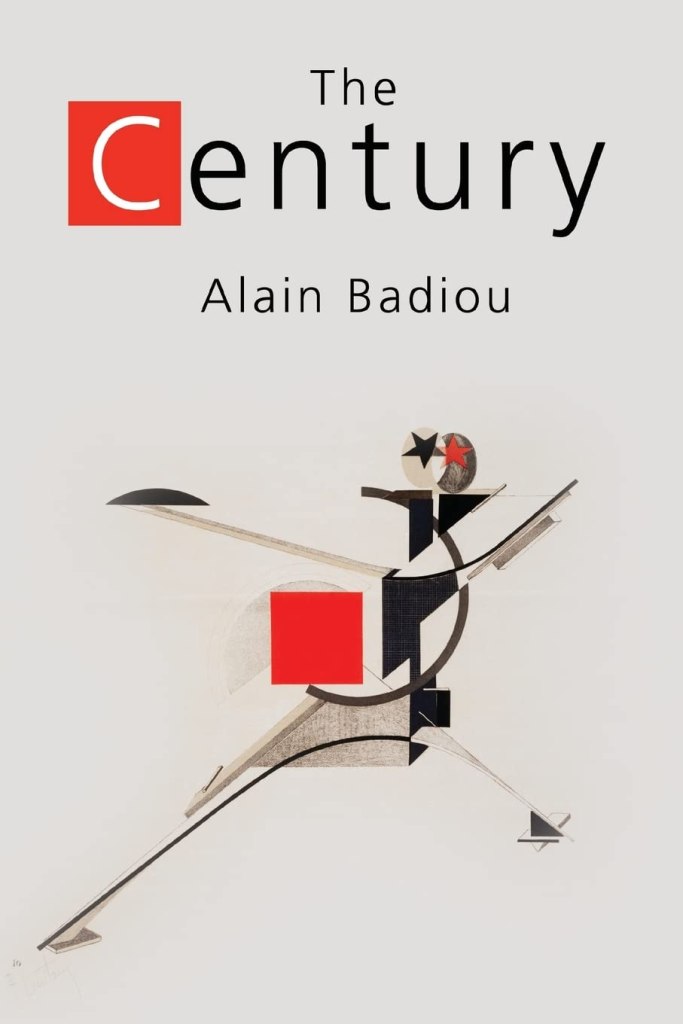
In The Century, Alain Badiou goes on an ambitious intellectual journey, seeking to re-examine the twentieth century not from the perspective of external judgment, but from the vantage point of the century itself. This crucial work is not an attempt to absolve or condemn the century, nor does Badiou assume the burden of defending it. Instead, he aims to understand what the twentieth century, in its own unfolding, proclaimed itself to be.
The twentieth century, often maligned as the era of totalitarian terror, genocides, failed utopias, and abstract ideologies, stands accused in the court of historical judgment. Badiou does not plead for this accused; he believes the century can defend itself. His purpose is to reopen the dossier on this maligned century, not as a dispassionate judge but from within the century’s own narrative. He investigates how the century described itself, what it claimed, and what it aspired to become.
Badiou begins by questioning the very concept of a century. Drawing on Jean Genet and Bossuet, he interrogates whether a century is a philosophical object or merely a historical unit. He explores how significant events like the fall of the Berlin Wall, the mapping of the genome, and the launch of the euro might represent the century’s defining moments. Badiou proposes the idea of a “Soviet century,” beginning with the First World War and culminating in the collapse of the USSR, a period marked by war and revolution.
This exploration continues with an analysis of the “totalitarian century,” characterized by the crimes of Stalinism and Nazism, and epitomized by the Holocaust. Badiou delves into the intersection of state crime and mass murder, exploring the moral imperatives and ethical judgments that arise from such atrocities. He emphasizes the importance of numbers in ethical judgment, noting how the count of the dead becomes a critical aspect of historical reckoning.
Badiou’s method takes cues from the century itself, examining texts and events that reflect the era’s self-perception. He turns to the poetry of Osip Mandelstam, whose work captures the violent and chaotic spirit of the early Soviet period. Mandelstam’s poetry, written during the 1920s, reflects the tumultuous changes and intellectual ferment of the time. Badiou examines how Mandelstam’s poetic rebellion against Stalinist despotism provides insight into the century’s complex relationship with power and creativity.
The book also explores the theme of “unreconciliation,” focusing on the last twenty years of the century, which Badiou describes as the second Restoration. He highlights the period’s obsession with numbers, particularly in the context of economic measures like dollars and euros. Badiou critiques this era’s fetishization of numbers, comparing it with the concept of the “bad infinite” as described by Hegel. He argues that this period’s reliance on numerical representation reflects a deeper disconnection from reality.
Badiou further investigates the century’s passion for the real and its quest for new worlds. He examines how this drive manifests in the works of various intellectuals and artists, including Bertolt Brecht. Brecht, emblematic of the twentieth century, represents the struggle against romanticism and the search for a new German identity. Badiou explores Brecht’s engagement with Marxism, his critique of fascism, and his efforts to forge a new aesthetic and political language.
Throughout The Century, Badiou addresses the themes of sex, crisis, avant-gardes, and the infinite. He delves into how the century grappled with the disappearance of traditional concepts of man and God, and how European nihilism shaped philosophical discourse. The book concludes with a commentary by Alberto Toscano, who situates Badiou’s work within the broader context of contemporary philosophy and historical analysis.
The Century is a dense, detailed, and rigorous examination of the twentieth century from within its own unfolding. Badiou’s philosophical inquiry provides a unique perspective on a century marked by profound contradictions, immense creativity, and unprecedented violence. By allowing the century to speak for itself, Badiou offers a compelling and thought-provoking reassessment of an era that continues to shape our present and future.
 Simon Gros
Leave a comment