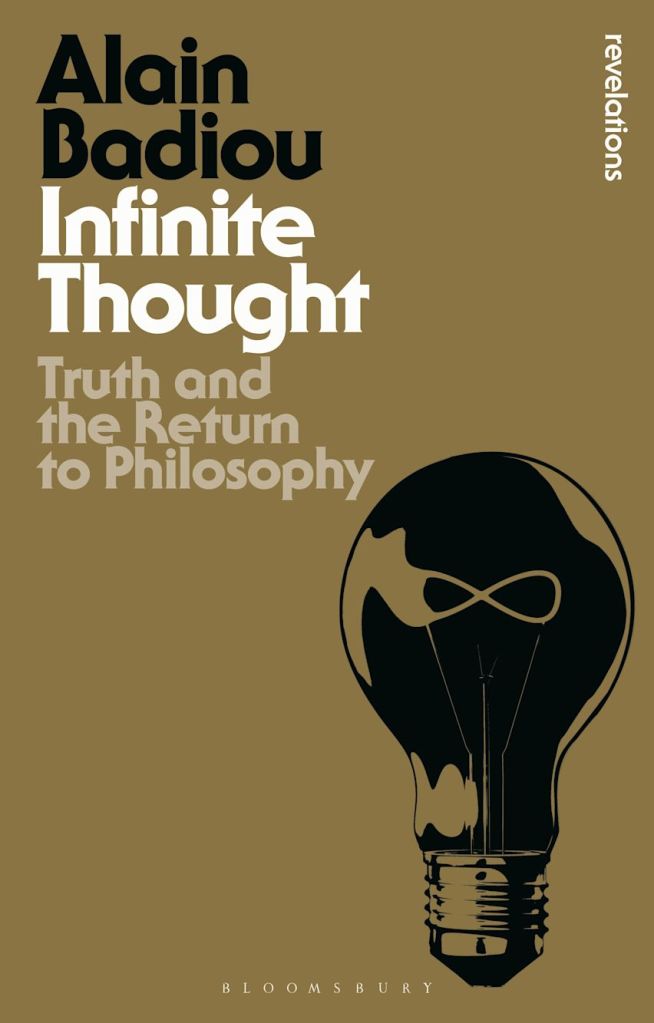
Alain Badiou’s Infinite Thought: Truth and the Return to Philosophy represents a monumental effort to redefine the concept of truth and reassert the importance of philosophy in contemporary intellectual discourse. Badiou addresses the profound crisis that philosophy faced in the 20th century, marked by the rise of poststructuralism and postmodernism, movements which questioned the very foundations of truth and knowledge. In stark contrast, Badiou champions a vision of truth that is neither relative nor subjective but is instead an eternal and infinite construct tied intrinsically to the concept of the event and the universal.
Badiou embarks on a rigorous philosophical journey that revisits and reinterprets the works of seminal thinkers like Plato, Descartes, and Kant. By engaging deeply with these philosophical giants, Badiou does not merely pay homage to their contributions; he critiques and expands upon their ideas, laying the groundwork for a new philosophical paradigm. This paradigm insists on the existence of universal truths that emerge through transformative events—moments that disrupt the status quo and reveal new dimensions of reality.
The book is a comprehensive treatise that traverses various domains of human thought and experience. Badiou explores the intersections of philosophy with politics, psychoanalysis, art, cinema, and the seismic shifts in the global political landscape, such as the fall of communism and the advent of the ‘War on Terror.’ Through these explorations, Badiou illustrates the ways in which philosophy can and must engage with the world, offering insights and frameworks that transcend mere academic speculation and engage with the very fabric of societal and existential reality.
Central to Badiou’s argument is the concept of the event, which he defines as a radical break from the ordinary flow of experience that reveals new truths and possibilities. These events are not merely historical occurrences but are imbued with the potential to transform the structures of knowledge and being. For Badiou, philosophy’s role is to recognize and affirm these events, to trace their implications, and to articulate the truths they unveil.
In addressing the crisis of contemporary philosophy, Badiou critiques both the poststructuralist tendency to dissolve truth into a play of differences and the analytical tradition’s confinement of truth to propositional logic. He proposes an alternative that draws on set theory from mathematics to offer a robust ontological framework. Badiou’s claim that “mathematics is ontology” signifies a radical shift in how we conceive of being and existence. Through this mathematical lens, he formulates an understanding of truth that is consistent, universal, and capable of engaging with the complexities of modern thought.
Badiou’s reflections on psychoanalysis, particularly through the lens of Lacanian theory, offer a unique perspective on the relationship between the subject and truth. He positions psychoanalysis as a form of thinking that, like philosophy, intertwines theory and practice in a manner that reveals the deep structures of subjectivity and desire. This interdisciplinary approach underscores Badiou’s commitment to a philosophy that is not isolated from other fields of human inquiry but is deeply interconnected with them.
The book also delves into the realms of art and cinema, demonstrating how these cultural forms can serve as sites for the emergence of truth. Badiou’s analysis reveals how artistic and cinematic expressions can encapsulate and communicate the truths of their time, serving as powerful vehicles for philosophical reflection and societal critique.
In his discussion of politics, Badiou challenges the notion that the end of communism signifies the end of emancipatory political projects. Instead, he argues for a renewed engagement with the political ideals of equality and justice, advocating for a philosophy that remains committed to transformative praxis. His critique of the ‘War on Terror’ further exemplifies his commitment to a philosophy that actively interrogates and opposes ideological constructs that perpetuate violence and oppression.
Infinite Thought culminates in an articulation of the definition of philosophy itself. For Badiou, philosophy is not merely a scholarly discipline but a vital, living practice that seeks to uncover and affirm truths that have the power to transform our understanding of the world and our place within it. This vision of philosophy as an active, engaged, and transformative practice is at the heart of Badiou’s project.
In an illuminating interview included in the book, Badiou reflects on his philosophical journey and clarifies some of his most challenging ideas. This interview offers readers a glimpse into the mind of one of the most provocative and influential philosophers of our time, providing valuable context and insight into his theoretical framework.
Infinite Thought is a profound and challenging work that demands deep engagement and reflection. It is a call for the return of philosophy to its rightful place at the forefront of intellectual and societal transformation. Through his rigorous analysis and bold theoretical innovations, Badiou offers a vision of philosophy that is capable of addressing the profound challenges of our time, reaffirming the enduring relevance and necessity of philosophical inquiry in the contemporary world.
 Simon Gros
Leave a comment