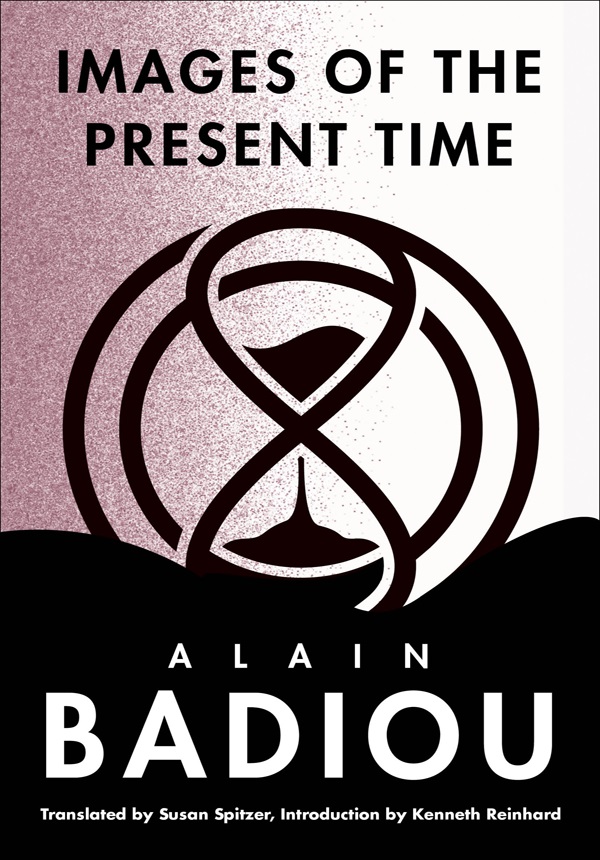
In Images of the Present Time, Alain Badiou presents an illuminating and multifaceted philosophical inquiry into the nature of contemporaneity and the challenge of living authentically within one’s own era. Spanning nearly three years of seminars from 2001 to 2004, this volume captures Badiou’s engagement with the existential and philosophical dilemmas of our time, against the backdrop of significant global events such as the Iraq War. As a sequel to his magnum opus Being and Event, particularly the work-in-progress Logics of Worlds, this collection of lectures offers a more conversational and accessible exploration of the philosophical concepts central to Badiou’s thought, enriching his prior work with a profound examination of how to be genuinely present in an era marked by what he perceives as its own profound worldlessness.
At the core of Badiou’s inquiry is the question of what it means to be contemporary. For Badiou, this involves not merely existing within a moment but actively creating a ‘real present’ that intertwines elements from both the past and the future. This philosophical project is deeply embedded in Badiou’s critique of what he terms ‘democratic materialism’—a worldview that, in his analysis, reduces existence to mere bodies and languages, devoid of universal truths or transformative potentials.
The book unfolds in three primary sections, each addressing different dimensions of this problem. The first section, titled “Contemporary Nihilism,” goes into the ways in which modern democracy, characterized by its apparent embrace of freedom and equality, fails to provide a meaningful or substantive world. Badiou critiques the idea that democracy, as it operates in practice, is synonymous with true freedom. Instead, he argues that democracy’s superficial tolerance masks a deeper commodification of human experience and a profound lack of genuine engagement with the real present.
Badiou’s central thesis in this section is that contemporary society is characterized by a form of nihilism where the symbolic and ideological frameworks that should provide coherence and meaning are instead hollowed out. He critiques the democratic ideal’s tendency to subsume everything into an equivalence, thereby precluding the possibility of a true world. The democratic era, for Badiou, represents a world where everything is equivalent to everything else, and this equivalence denies the emergence of a genuine present or meaningful action.
In the second section, “The Logic of Exceptions,” Badiou explores the potential for exceptions to the dominant democratic materialism. He identifies four key forms of non-circulation—demonstration, contemplation, action, and passion—that stand in contrast to the commodification and general equivalence of democratic materialism. Through this lens, Badiou examines how mathematical theorems, works of art, political actions, and romantic love can serve as avenues for the emergence of new truths that resist the reductive logic of commodity circulation.
Badiou’s examination of these exceptions is not merely theoretical but deeply practical, aiming to show how these realms can introduce transformative potentials into a world otherwise constrained by its own commodifying logic. For Badiou, these exceptions are not merely anomalies but integral to the process of creating a genuine present, one that engages with and transcends the limitations imposed by the current ideological landscape.
The final section of the book, “What Does It Mean to Live?,” delves into the philosophical question of existence and what it means to truly live within a present time. This section reflects on Badiou’s earlier works, especially Logics of Worlds, and offers a critical appraisal of democratic materialism’s ordinary metaphysics. He challenges the reduction of existence to mere bodies and languages and argues for the need to envision a reality that includes universals and ideas beyond the purely materialistic and linguistic framework.
Badiou reflects on his journey leading to this seminar, particularly his engagement with anti-philosophy. For several years, he immersed himself in the works of philosophers like Nietzsche, Wittgenstein, Lacan, and Saint Paul, who critique traditional philosophy for often ignoring the singularity of individual experience in favour of abstract systems. This exploration was not just an academic endeavour for Badiou but a deliberate attempt to challenge and reformulate his own understanding of the subject. He sought to address anti-philosophical critiques by reworking his theory of the subject, aiming to reconcile individual uniqueness with the pursuit of universal truths.
A central theme in Badiou’s work is whether philosophy can genuinely engage with the present or if it is always retrospectively engaged. He engages critically with Hegel’s notion that philosophy always arrives “after” the events it seeks to understand. According to Hegel, the “owl of Minerva” flies only at dusk, symbolizing that philosophical reflection comes only after events have occurred and their meanings have begun to be discerned. This idea implies that philosophy is perpetually nostalgic for the past, always reflecting on what has already happened rather than engaging directly with the present.
Badiou challenges this notion, questioning if philosophy is doomed to always seek a present that has already slipped away. This concern reflects a broader philosophical issue: the difficulty of capturing and articulating the essence of the present moment.
To address these questions, Badiou employs a methodological framework illustrated through an analysis of Jean Genet’s play The Balcony. This play serves as a case study for exploring the nature of the present and its representations. Badiou’s approach involves analysing the systemic structure of a historical moment, identifying exceptions to this structure, examining how the structure is preserved in the face of these exceptions, and understanding how emblems represent and conceal the power of the structure.
In The Balcony, Badiou illustrates these stages. The systemic figure is represented by the brothel, the play’s setting. The revolutionary figures, who challenge the established order, represent the real tracing. The Chief of Police symbolizes the naked power behind the structure, while the emblems are the symbols and figures that represent and obscure the structure’s power.
Badiou’s exploration in Images of the Present Time seeks to address how contemporary philosophy can engage with and understand the present. By analysing the dynamics of structures, their interaction with exceptions, and the role of emblems in representing and concealing power, Badiou aims to offer a more nuanced understanding of the present moment. His work challenges the idea that philosophy is inherently out of sync with its time, suggesting instead that a thoughtful examination of the present through its representations and structural dynamics can yield meaningful insights.
Images of the Present Time is a philosophical exploration and call to rethink how we engage with our own time. Badiou’s work challenges readers to consider how they might transcend the limitations of contemporary nihilism and engage with a more meaningful and transformative present. This volume represents a crucial contribution to contemporary philosophy, offering insights into how one might navigate and reshape the present in a way that is both theoretically robust and practically significant.
Throughout this volume, Badiou engages with a wide range of intellectual and cultural references, including literature, theater, and contemporary politics, to illuminate his philosophical arguments. His analysis is both rigorous and accessible, making complex ideas relatable to readers interested in the practical implications of his thought.
Alain Badiou is an eminent French philosopher known for his profound and innovative contributions to contemporary thought. A professor emeritus at the École Normale Supérieure in Paris, Badiou’s work spans various domains, including ontology, politics, and aesthetics. His notable publications include Being and Event and Logics of Worlds. Images of the Present Time captures Badiou’s incisive analysis of the present era, reflecting his deep engagement with philosophical, political, and cultural issues.
The English edition of Images of the Present Time is translated by Susan Spitzer, with Kenneth Reinhard providing editorial oversight. Their work ensures that Badiou’s complex ideas are rendered with precision and clarity, making this volume accessible to a broader audience of English-speaking readers.
 Simon Gros
Leave a comment