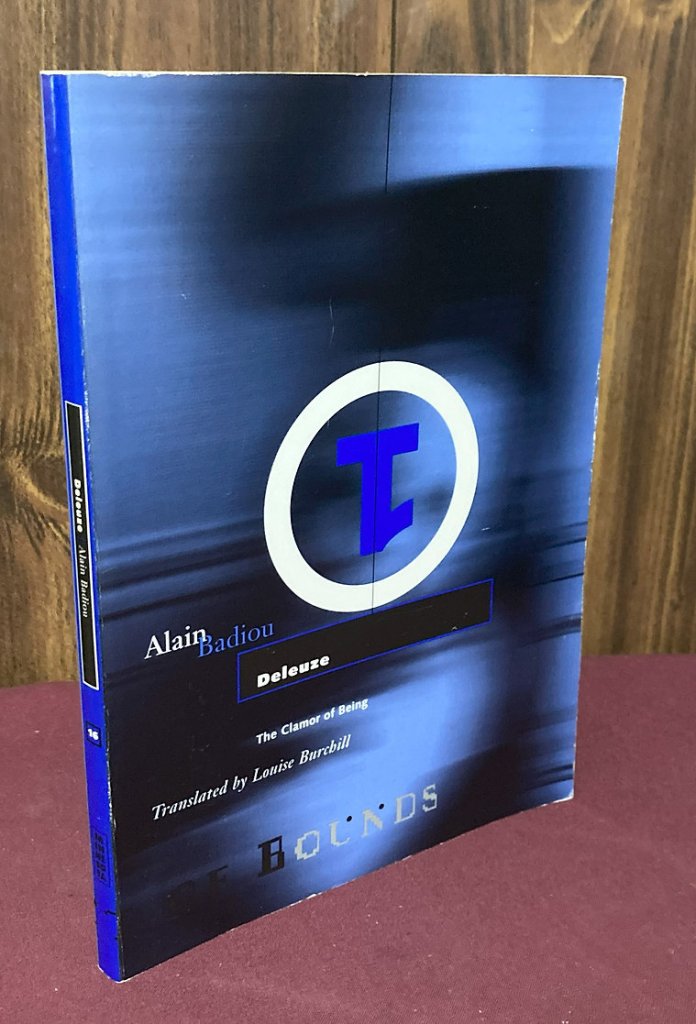
Alain Badiou’s Deleuze: The Clamor of Being is a profound and audacious reexamination of Gilles Deleuze’s philosophical legacy, presenting a starkly different interpretation of Deleuze’s work. This critical volume, the first major work by Badiou available in English, not only offers a fresh perspective on Deleuze but also provocatively redefines what it means to be “Deleuzian.” Badiou’s contention that Deleuze is an ascetic philosopher of Being and Oneness, rather than the Dionysian thinker of becoming and multiplicity he is often taken to be, sets the stage for a philosophical confrontation that challenges widely held views and offers new insights into Deleuze’s thought.
Gilles Deleuze, known for his extensive and influential works on cinema, literature, painting, and philosophy, is often celebrated as a thinker of desire, flux, and multiplicity. His explorations in Anti-Oedipus, A Thousand Plateaus, and other seminal texts have established him as a leading figure in post-structuralist and postmodern philosophy. However, Badiou, through meticulous and attentive readings of Deleuze’s key concepts, argues that beneath Deleuze’s apparent anti-Platonism and advocacy for the multiplicity of desires lies a fundamental commitment to the univocity of Being, a concept that aligns him more closely with a Platonic tradition than is commonly acknowledged.
Badiou’s argument rests on a detailed philosophical engagement with Deleuze’s writings, contending that Deleuze’s philosophy ultimately revolves around a rigorous determination of Being as One. This interpretation contrasts sharply with the prevailing view of Deleuze as a philosopher who celebrates chaos, flux, and the continuous process of becoming. For Badiou, Deleuze’s emphasis on the univocity of Being means that all differences and multiplicities are subsumed under a single, overarching unity. This reading challenges the notion of Deleuze as a thinker who radically opposes Platonic ideals, suggesting instead that Deleuze’s work can be seen as a sophisticated, albeit unintended, restoration of a Platonic framework.
Badiou’s reappraisal is grounded in his broader philosophical project, which seeks to develop a contemporary form of Platonism. In this context, Badiou critiques Deleuze’s anti-Platonism as a superficial opposition that fails to overturn the fundamental Platonic commitment to the primacy of Being. By emphasizing Deleuze’s univocity of Being, Badiou argues that Deleuze remains tethered to a Platonic vision where the multiplicity of the world is ultimately grounded in a singular ontological reality.
One of the key aspects of Badiou’s critique is his challenge to the interpretation of Deleuze as a thinker of desire and anarchic multiplicity. Badiou argues that Deleuze’s philosophy, despite its apparent celebration of difference and becoming, is deeply ascetic. This asceticism is reflected in Deleuze’s commitment to an egalitarian affirmation of what is, which Badiou sees as a rigorous and disciplined approach to thought. According to Badiou, Deleuze’s focus on the univocity of Being and the rigorous determination of multiplicity as One points to an underlying asceticism that contrasts with the more common view of Deleuze as an advocate for unrestrained desire and creative chaos.
Badiou’s reinterpretation of Deleuze also addresses the ethical dimension of Deleuze’s work. While Deleuze is often seen as an advocate for an ethics of immanence and affirmation, Badiou’s reading suggests that this ethical stance is deeply connected to Deleuze’s ontological commitments. By affirming the univocity of Being, Deleuze proposes an ethical framework that emphasizes the acceptance and affirmation of all that exists, without recourse to transcendent ideals or external standards. This ethical dimension, according to Badiou, is crucial for understanding the true nature of Deleuze’s philosophical project.
The relationship between Badiou and Deleuze is complex and multifaceted, marked by both philosophical convergence and divergence. Their correspondence near the end of Deleuze’s life, which Badiou draws upon in this volume, reveals a shared concern with similar philosophical problems, despite their differing approaches and conclusions. This exchange of ideas highlights the deep intellectual engagement between the two thinkers and underscores the significance of Badiou’s reappraisal of Deleuze’s work.
Badiou’s critique also engages with Deleuze’s use of mathematical and scientific concepts, particularly his reliance on differential calculus and Riemannian manifolds. Badiou contrasts this with his own preference for set theory and algebra, arguing that Deleuze’s metaphors from mathematics serve to obscure the underlying ontological commitments of his philosophy. By emphasizing the virtual and the plane of immanence, Deleuze constructs a framework where the virtual precedes and conditions the actual, a move that Badiou sees as problematic in its implications for understanding the nature of Being and multiplicity.
In revisiting Deleuze’s key concepts such as the nomad, the fold, and the rhizome, Badiou offers a reinterpretation that places these ideas within the context of Deleuze’s commitment to the univocity of Being. For instance, the nomad, often seen as a figure of radical freedom and deterritorialization, is reinterpreted by Badiou as an expression of Deleuze’s ontological commitment to the One. Similarly, the fold, which Deleuze uses to describe the intricate interweaving of the virtual and the actual, is seen by Badiou as a metaphor for the underlying unity that governs Deleuze’s thought.
Badiou’s analysis also extends to Deleuze’s engagement with other philosophers, such as Spinoza, Nietzsche, and Bergson. By examining these influences, Badiou highlights the ways in which Deleuze’s thought both aligns with and diverges from these figures. In particular, Badiou’s reading of Deleuze’s Spinozism reveals a complex relationship where Deleuze’s interpretation of Spinoza’s immanence and univocity is seen as both a continuation and a transformation of Spinoza’s ideas.
Ultimately, Deleuze: The Clamor of Being is a critical tour de force that repositions Deleuze within the landscape of contemporary philosophy. Badiou’s reinterpretation challenges readers to rethink their understanding of Deleuze’s work, offering new insights and opening up fresh avenues for philosophical exploration. By situating Deleuze within a Platonic framework and emphasizing his commitment to the univocity of Being, Badiou provides a compelling and provocative account that reshapes the legacy of one of the most important thinkers of our time.
This volume not only serves as an introduction to Badiou’s own philosophical project but also as an invitation to engage more deeply with the complexities and nuances of Deleuze’s thought. For both seasoned scholars and newcomers to Deleuze, Badiou’s book offers a rich and challenging perspective that demands careful consideration and thoughtful reflection. Through this critical engagement, Badiou reinvigorates the debate over Deleuze’s legacy and contributes to the ongoing dialogue about the future direction of contemporary philosophy.
 Simon Gros
Leave a comment