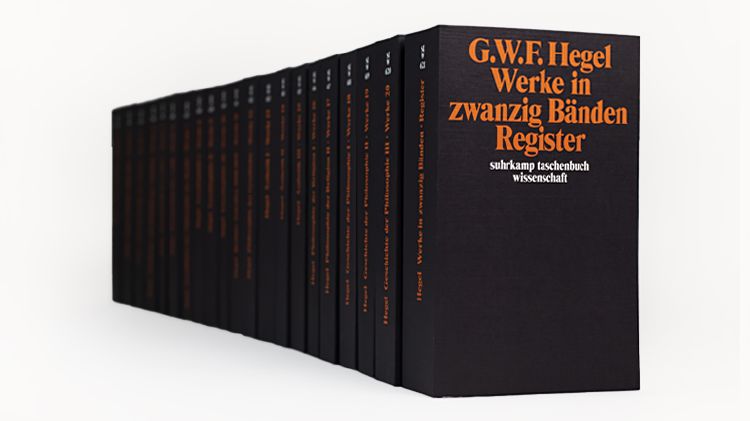
The Hegel Werke, edited by Karl Markus Michel and Eva Moldenhauer, is an unprecedented scholarly achievement, offering a comprehensive and accessible edition of Georg Wilhelm Friedrich Hegel’s extensive body of work. This twenty-volume edition spans over 11,000 pages, providing an organized and affordable resource for engaging with Hegel’s philosophical contributions.
This collection brings together nearly the entire range of Hegel’s philosophical output, encapsulating his intellectual evolution from his formative early writings through his mature and influential works. It includes seminal texts such as the Phänomenologie des Geistes (Phenomenology of Spirit), which explores the development of human consciousness and self-awareness, and the Wissenschaft der Logik (Science of Logic), which presents a rigorous analysis of logic and its role in philosophical thinking. Additionally, it includes his Grundlinien der Philosophie des Rechts (Philosophy of Right), where Hegel developes political theory and ethical life, and the Enzyklopädie der philosophischen Wissenschaften (Encyclopedia of the Philosophical Sciences), a comprehensive overview of his philosophical system.
The collection also features extensive lecture series, including the Vorlesungen über die Philosophie der Geschichte (Lectures on the Philosophy of History), where Hegel articulates his views on historical development and the evolution of human societies, and the Vorlesungen über die Ästhetik (Lectures on Aesthetics), which address his theories on art, beauty, and artistic expression. His lectures on the philosophy of religion also provide an exploration of religious concepts and their philosophical implications.
This edition is distinguished by its dedication to textual fidelity and readability. It has been carefully edited to ensure accuracy while making Hegel’s complex ideas more accessible to contemporary readers. The editors have succeeded in balancing the preservation of Hegel’s dialectical method with the practical needs of modern scholars and students.
Hegel’s philosophy remains highly relevant in today’s intellectual landscape. His dialectical method, which explores the dynamic interplay between opposing ideas and their advancement into higher stages, continues to influence contemporary thought across various fields, including political theory, social philosophy, and aesthetics. The notion of historical development as a progressive rational process provides a framework for understanding societal transformations, which remains pertinent in analysing current global issues and historical changes.
Hegel’s insights into the nature of freedom, ethical life, and the state offer valuable perspectives for contemporary discussions on democracy, individual rights, and social justice. His exploration of the interconnectedness of individual and collective identity, as well as his analysis of the role of history in shaping human consciousness, resonate with ongoing debates about identity, community, and historical narrative.
In an era marked by rapid social and political change, Hegel’s work provides a solid theoretical foundation for examining the complexities of modern life. His emphasis on the development of human consciousness and self-realization continues to inspire philosophical inquiry into the nature of human existence and the structure of societal institutions.
Table of Contents:
- Volume 1: Frühe Schriften (Early Writings)
- Volume 2: Jenaer Schriften 1801-1807 (Jena Writings 1801-1807)
- Volume 3: Phänomenologie des Geistes (Phenomenology of Spirit)
- Volume 4: Nürnberger und Heidelberger Schriften 1808-1817 (Nuremberg and Heidelberg Writings 1808-1817)
- Volume 5: Wissenschaft der Logik I (Science of Logic I)
- Volume 6: Wissenschaft der Logik II (Science of Logic II)
- Volume 7: Grundlinien der Philosophie des Rechts (Elements of the Philosophy of Right)
- Volume 8: Enzyklopädie der philosophischen Wissenschaften I (Encyclopedia of the Philosophical Sciences I)
- Volume 9: Enzyklopädie der philosophischen Wissenschaften II (Encyclopedia of the Philosophical Sciences II)
- Volume 10: Enzyklopädie der philosophischen Wissenschaften III (Encyclopedia of the Philosophical Sciences III)
- Volume 11: Berliner Schriften 1818-1831 (Berlin Writings 1818-1831)
- Volume 12: Vorlesungen über die Philosophie der Geschichte (Lectures on the Philosophy of History)
- Volume 13: Vorlesungen über die Ästhetik I (Lectures on Aesthetics I)
- Volume 14: Vorlesungen über die Ästhetik II (Lectures on Aesthetics II)
- Volume 15: Vorlesungen über die Ästhetik III (Lectures on Aesthetics III)
- Volume 16: Vorlesungen über die Philosophie der Religion I (Lectures on the Philosophy of Religion I)
- Volume 17: Vorlesungen über die Philosophie der Religion II (Lectures on the Philosophy of Religion II)
- Volume 18: Vorlesungen über die Geschichte der Philosophie I (Lectures on the History of Philosophy I)
- Volume 19: Vorlesungen über die Geschichte der Philosophie II (Lectures on the History of Philosophy II)
- Volume 20: Vorlesungen über die Geschichte der Philosophie III (Lectures on the History of Philosophy III)
Hegel’s philosophy is an enormous contribution to the landscape of Western thought, characterized by its comprehensive approach to understanding reality, history, and human consciousness. Central to Hegel’s system is the notion that philosophy’s true insight into the nature of reality can only be achieved retrospectively. This idea is encapsulated in his assertion that “the owl of Minerva begins its flight only with the falling of dusk,” suggesting that philosophical understanding emerges only after the historical events it seeks to interpret have reached their conclusion.
At the heart of Hegel’s thought is the dialectical method, which he employs to explore the development of ideas and historical processes. The dialectical process is not merely a sequence of opposing ideas but a dynamic and rational unfolding where each stage of development contains the previous contradictions within. This process reflects Hegel’s view that history and thought evolve through a series of conflicts and resolutions, driving forward the development of human consciousness and social forms.
Hegel’s philosophy introduces the concept of “Absolute Knowing,” which represents the culmination of the dialectical process. Absolute Knowing is a state of self-consciousness that fully grasps the unity of the subjective and objective realms. It is achieved not as a final destination but as an ongoing process of understanding that emerges after a thorough dialectical examination of prior stages. This comprehensive grasp of reality recognizes the interconnectedness of different aspects of existence and reflects the continuous evolution of thought.
In his work Philosophy of Right, Hegel explores the concept of ethical life (Sittlichkeit) and its evolution through different historical stages. He examines traditional societies, which possess an implicit moral order but lack the individuality characteristic of modern societies, and modern societies, which, despite their advanced sense of freedom, are marked by alienation. Hegel posits that the evolution of ethical life involves reconciling individual freedom with a coherent moral order, although he does not prescribe a definitive model for future societies. Instead, he provides a framework for understanding the historical development of ethical norms and practices.
A significant aspect of Hegelian philosophy is the concept of “recollective forgiveness,” which involves a reflective and nuanced understanding of past actions. This approach goes beyond mere forgiveness and requires an acknowledgment of the complex interplay between intentions, consequences, and the perspectives of those involved. Hegel’s treatment of forgiveness challenges simplistic moral judgments and advocates for a deeper comprehension of historical and ethical contexts.
Hegel’s influence extends beyond his own time, impacting contemporary debates on morality, ethics, and historical interpretation. His emphasis on the retrospective nature of philosophical insight and the dialectical development of ideas offers valuable perspectives for analysing modern issues, such as political correctness, historical injustices, and evolving ethical norms. Hegel’s philosophy encourages a critical examination of how we engage with the past and highlights the complexities involved in ethical reflection.
Hegel’s philosophy provides a sophisticated framework for understanding the development of ideas, history, and consciousness. It emphasizes the retrospective nature of philosophical insight, the dynamic and dialectical progression of thought, and the complex nature of ethical reflection. Hegel’s contributions continue to offer helpful insights into both historical and contemporary issues, demonstrating the ongoing relevance of his philosophical system.
The Hegel Werke offers a crucial resource for engaging deeply with Hegel’s philosophical vision, providing a comprehensive and accessible collection that reflects both historical significance and contemporary relevance.
 Simon Gros
Leave a comment