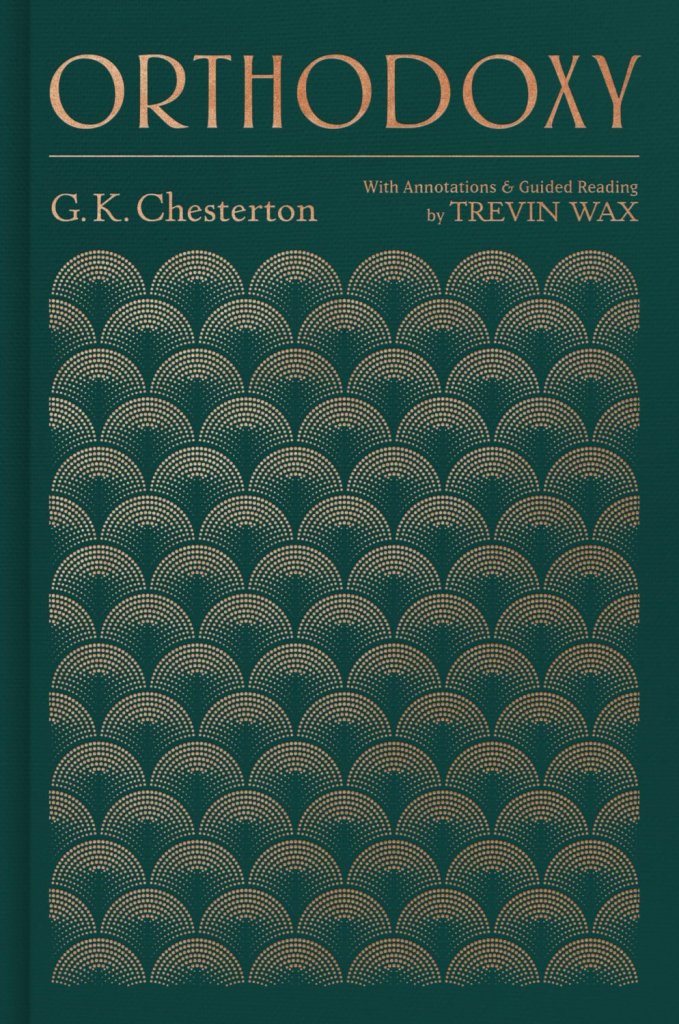
Gilbert Keith Chesterton, one of the most celebrated and esteemed figures in modern literature, offers an intellectual and spiritual tour de force in his seminal work, Orthodoxy. Chesterton, renowned for his prodigious output as a playwright, novelist, poet, literary commentator, essayist, and apologist, distils his vibrant and multifaceted philosophy into this compelling spiritual autobiography.
Born into a world of agnosticism, Chesterton’s personal journey from paganism at twelve to a deeply held Christian faith by adulthood is chronicled with eloquence and profundity in Orthodoxy. The book an exposition of theological arguments and an engaging narrative of Chesterton’s own existential grappling and eventual embrace of orthodox Christianity. Written in response to the criticism of his earlier work, Heretics, this 1908 publication provides a counterbalance by outlining the positive case for Christian orthodoxy rather than simply rebutting secular views.
In Orthodoxy, Chesterton addresses the timeless human needs and existential questions that transcend generations. His approach is not to rationalize away the paradoxes of the Christian faith but to celebrate them as intrinsic to its truth and beauty. This work stands as a timeless argument for the plausibility of traditional Christianity, appealing to readers facing the same materialism and anti-supernaturalism that Chesterton contended with in his time.
The book begins with an exploration of Chesterton’s initial skepticism and the subsequent intellectual journey. He combines personal anecdotes with philosophical musings, leading readers through his realization that orthodoxy is the most coherent and satisfying answer to the complexities and contradictions of human existence. Central is the idea that Christian orthodoxy, rather than being a set of arbitrary doctrines, naturally aligns with the deep-seated human experience of wonder and rationality, providing a framework that embraces both the mundane and the mysterious.
Chesterton’s distinctive style is evident from the opening lines of the book, where he states, “The only possible excuse for this book is that it is an answer to a challenge. Even a bad shot is dignified when he accepts a duel.” This sets the stage for a narrative that is both personal and universal. He recounts how critics of Heretics, especially G. S. Street, challenged him to present his own cosmic theory rather than merely critiquing others. In response, Chesterton writes, “If he does read it, he will find that in its pages I have attempted in a vague and personal way, in a set of mental pictures rather than in a series of deductions, to state the philosophy in which I have come to believe. I will not call it my philosophy; for I did not make it. God and humanity made it; and it made me.”
Orthodoxy is structured around key themes that Chesterton explores with his characteristic wit and erudition. He juxtaposes the seeming contradictions of faith with the incoherence he perceives in purely secular worldviews. Through chapters like “The Maniac,” where he discusses the limits of rationalism, and “The Ethics of Elfland,” where he argues for the enchantment of the ordinary, Chesterton systematically builds his case for a faith that is both intellectually robust and spiritually fulfilling.
The book’s conclusion, “The Romance of Orthodoxy,” encapsulates Chesterton’s belief in the Christian faith as a narrative that meets the dual human needs for adventure and security. He asserts that Christianity, with its blend of mystery and familiarity, offers a vision of the world that is at once startling and comforting. Chesterton’s prose is both lyrical and incisive, making Orthodoxy a compelling read not just for theologians but for anyone grappling with the fundamental questions of life.
Chesterton presents the Christian faith as uniquely suited to meet various needs, for a life that is “practical romance; the combination of something that is strange with something that is secure.” He explains, “We need so to view the world as to combine an idea of wonder and an idea of welcome. We need to be happy in this wonderland without once being merely comfortable. It is this achievement of my creed that I shall chiefly pursue in these pages.”
Orthodoxy has been profoundly influential, shaping the thoughts of many notable figures, including C.S. Lewis, who credited it as a pivotal step in his own journey to faith. The book’s impact extends beyond individual conversions; it has sparked ongoing discussions about the relevance and rationality of Christianity in the modern world.
This work is a testament to Chesterton’s enduring legacy as a master of English prose and a formidable apologist. His ability to combine humour, logic, and narrative flair makes Orthodoxy a unique and essential read for anyone interested in the intersections of faith, philosophy, and literature.
G. K. Chesterton was a prolific and beloved author, whose works span numerous genres and themes. His notable books include The Everlasting Man, The Man Who Was Thursday, and the Father Brown mystery stories. Chesterton’s writings continue to inspire and challenge readers with their depth, wit, and insight into the human condition.
 Simon Gros
Leave a comment