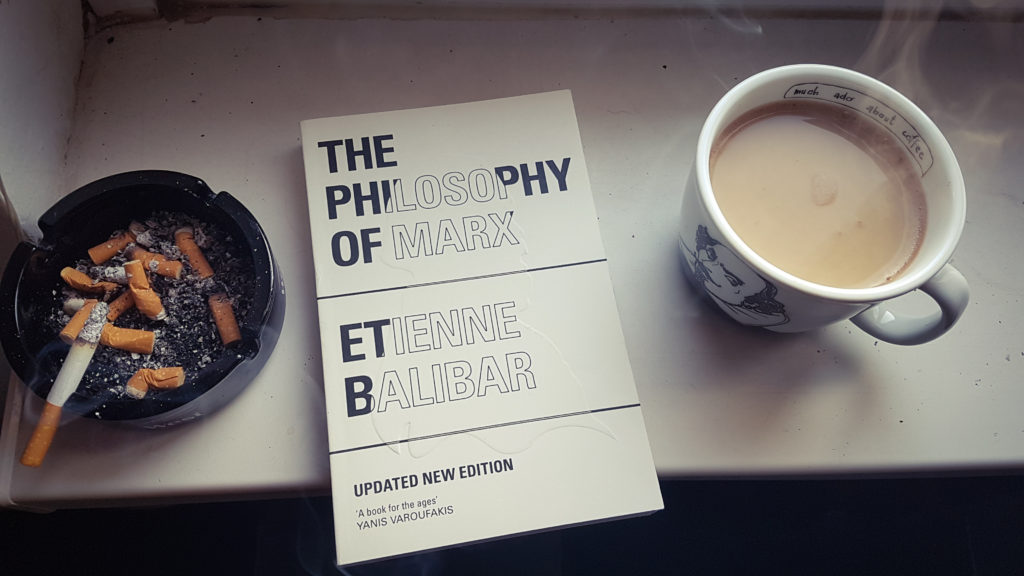
Étienne Balibar’s The Philosophy of Marx is a comprehensive examination of Karl Marx’s philosophical contributions, authored by one of the foremost thinkers in political theory. This updated edition, featuring a substantial new introduction and additional material, reasserts its standing as the essential guide to Marx’s thought, seamlessly integrating historical contexts and contemporary significance.
Balibar dissects Marx’s key concepts, including class struggle, ideology, humanism, progress, determinism, commodity fetishism, and the state. He positions these concepts within a broader historical and theoretical framework, offering readers a panoramic view of Marx’s intellectual landscape. This approach not only clarifies Marx’s ideas but also situates them within the ongoing philosophical and political debates they have inspired.
The book opens with a provocative thesis: there is no unified ‘Marxist philosophy’ in the traditional sense, yet Marx’s influence on the philosophical discourse is more critical than ever. Balibar argues that Marx’s thought represents a radical departure from and a challenge to the established norms of philosophy. This thesis is explored through a detailed analysis of how Marx’s ideas transcend traditional philosophical boundaries, blending historical materialism with a critique of ideology and capitalist society.
Balibar’s exploration reveals the complexity and depth of Marx’s thought. He discusses how Marx’s critiques of political economy and capitalist society are intertwined with his philosophical insights, creating a body of work that is both historically grounded and theoretically innovative. This duality is reflected in Marx’s critique of Hegelian dialectics and his development of historical materialism, a method that emphasizes the material conditions of human existence as the foundation for understanding social and political change.
The updated edition includes new material that enhances the reader’s understanding of Marx’s continuing relevance in the 21st century. Balibar addresses contemporary issues and debates, demonstrating how Marx’s ideas can be applied to modern political and social struggles. This makes the book not just a historical analysis, but a living document that speaks to the current political and philosophical climate.
To aid readers, especially students, Balibar includes key information boxes that distil complex theories into accessible explanations. These provide valuable summaries and clarifications, making the book an excellent resource for both beginners and advanced scholars. They ensure that even the most challenging aspects of Marx’s thought are approachable and comprehensible.
Esteemed reviewers such as Fredric Jameson, Immanuel Wallerstein, and Benjamin Kunkel have praised Balibar’s work for its intelligence, originality, and clarity. Jameson highlights the book’s ability to challenge traditional philosophy and illuminate Marxism’s unique contributions. Wallerstein commends Balibar’s lucid analysis and its relevance to contemporary issues, while Kunkel notes that the book serves as both an introduction and a sophisticated commentary on Marx.
Balibar’s discussion includes a critical analysis of Marx’s relationship with traditional philosophy. He explores how Marx’s anti-philosophical stance—his rejection of abstract philosophical speculation in favor of concrete historical analysis—poses a fundamental challenge to the discipline of philosophy itself. This is particularly evident in Marx’s critique of ideology, where he argues that philosophical ideas often serve to obscure the real conditions of social and economic life.
Furthermore, Balibar delves into the historical development of Marxist thought, tracing its evolution from Marx’s original writings through its various interpretations and adaptations by later thinkers and political movements. This historical perspective provides a deeper understanding of how Marx’s ideas have been both applied and contested over time.
The book is an essential resource for anyone seeking to understand Marx’s impact on philosophy and political theory. It offers a nuanced and comprehensive analysis that bridges the gap between historical context and contemporary relevance, making it an invaluable addition to the study of one of the most important thinkers of the past two centuries. Balibar’s work not only illuminates Marx’s ideas but also engages with them critically, inviting readers to consider their implications for today’s world.
 Simon Gros
Leave a comment