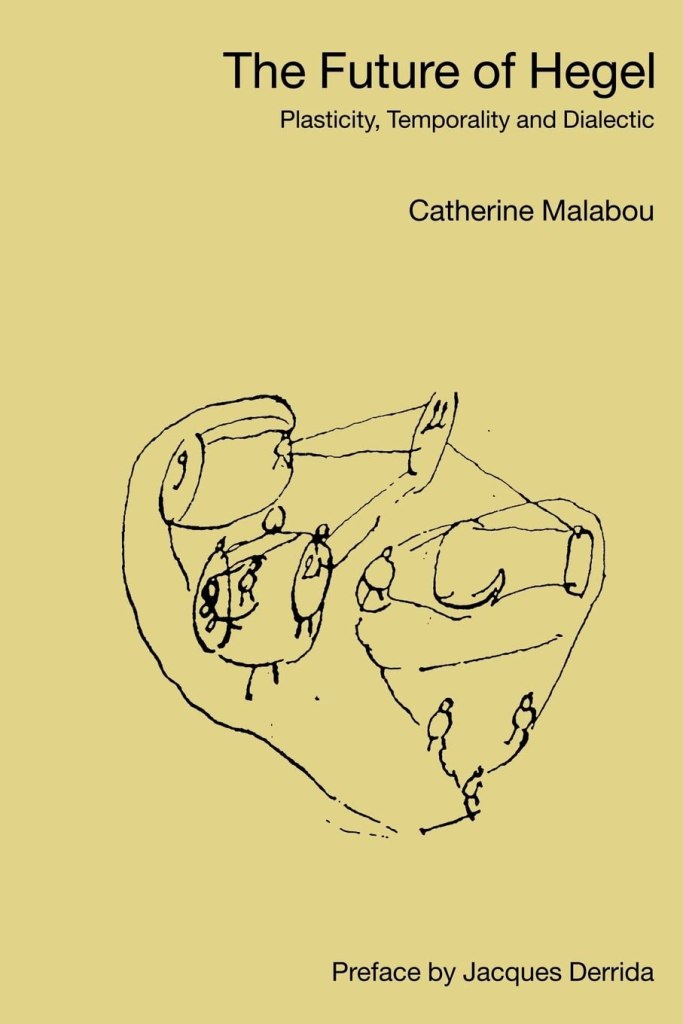
Catherine Malabou’s The Future of Hegel emerges as a profound and transformative contribution to contemporary continental philosophy, offering a reinvigorated perspective on Hegel’s thought. It represents a significant event in the ongoing dialogue surrounding Hegel’s legacy and its relevance to modern philosophical concerns.
Malabou’s work is situated at the intersection of classical Hegelian philosophy and cutting-edge theoretical discourse, demonstrating how Hegel’s ideas continue to resonate with and challenge contemporary philosophical issues. Her focus on the concept of ‘plasticity’—a term she deftly derives from Hegel’s Phenomenology of Spirit—serves as the cornerstone of her reinterpretation. By emphasizing plasticity, Malabou highlights the dynamic nature of Hegelian temporality and its capacity to shape and be shaped by evolving interpretations.
In this groundbreaking study, Malabou posits that the future, according to Hegel, should not be understood merely as a sequential moment in time, but as a fundamentally flexible and transformative force. This reinterpretation challenges static and deterministic views of temporal progression, suggesting instead that the future is an open and malleable dimension that is continuously redefined through our actions and interpretations. This insight provides a fresh lens through which to view Hegel’s dialectical method and its implications for understanding historical and personal development.
Central to Malabou’s argument is a critical engagement with Martin Heidegger’s interpretation of Hegelian temporality as presented in Being and Time. Heidegger’s analysis is often seen as a defining moment in the reception of Hegel’s philosophy, yet Malabou argues that his account is insufficient to capture the full complexity of Hegel’s conception of time. Instead, she contends that plasticity—an idea that Hegel himself hinted at but did not fully develop—offers a more accurate and fertile framework for understanding Hegel’s thought. Through plasticity, Malabou addresses how temporality is not just a backdrop to historical events but an active force that interacts with and shapes the substance of reality.
The book further explores Hegel’s engagement with the philosophical traditions of Greek thought and Christian theology, revealing how these historical and religious contexts deeply inform his philosophical inquiries. Malabou examines how Hegel’s reflections on substance, accident, and subjectivity are intertwined with his broader metaphysical and theological concerns. This examination sheds light on Hegel’s complex view of history and the role of divine and secular narratives in shaping human understanding.
Jacques Derrida’s preface to the book enriches its philosophical import by framing Malabou’s analysis within the broader discourse on time and historical understanding. Derrida’s preface is not merely an introductory note but a critical reflection that deepens the reader’s engagement with the themes of the book. His meditations on the future as a historical and philosophical problem resonate with Malabou’s arguments and underscore the importance of rethinking Hegel’s contributions in light of contemporary debates.
The Future of Hegel is essential reading for those invested in Hegelian philosophy, contemporary continental thought, and the intersections between philosophical, theological, and historical analysis. Malabou’s work is particularly relevant for scholars interested in the evolving interpretations of Hegel’s dialectic, as well as those engaged with the philosophical traditions of Heidegger and Derrida. Her innovative approach revitalizes Hegelian concepts and offers a critical framework for understanding the dynamic nature of time and the future.
Catherine Malabou’s role as a leading figure in contemporary philosophy is underscored by her profound engagement which bridges philosophical, neurological, and socio-political discourses. Her work continues to influence what is known as “The New French Philosophy,” positioning The Future of Hegel as a pivotal text that challenges, enriches, and expands the landscape of modern philosophical inquiry.
 Simon Gros
Leave a comment