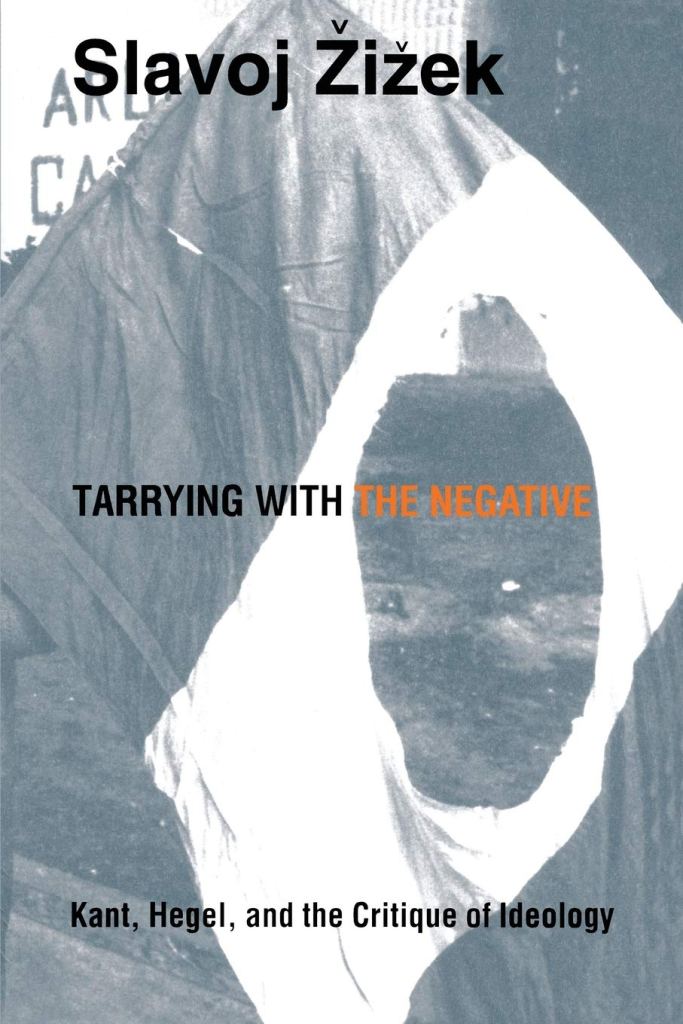
In Tarrying with the Negative, Slavoj Žižek embarks on an audacious journey that traverses the depths of German Idealism and contemporary ideological critique. In the early 1990’s, within a few years and through a quartet of transformative works, Žižek has asserted himself as a preeminent and controversial voice in modern philosophy, bringing to light the profound relevance of Jacques Lacan’s theories in deciphering the complexities of the contemporary era.
Žižek confronts the modern critique of ideology head-on, questioning whether we are irrevocably ensnared in a postmodern reality where truth is reduced to the transient outcomes of various discursive practices, and our subjectivity is fragmented across multiple ideological positions. Contrary to this deterministic view, Žižek argues for a radical return to philosophy, specifically the critical frameworks established by Immanuel Kant and Georg Wilhelm Friedrich Hegel. This return is not nostalgic but a strategic manoeuvre to reclaim the critique of ideology as a potent analytical tool capable of unveiling the underlying dynamics of our society.
At the heart of Žižek’s exploration is a penetrating analysis of social conflicts, particularly the resurgent waves of nationalism and ethnic struggle. He situates these phenomena within the broader context of cultural politics, highlighting the Balkan conflicts as a poignant illustration. Žižek posits that the ideological fervour driving nationalist and ethnic antagonisms is fundamentally rooted in a collective denial of our inherent enjoyment, an insight that draws heavily on Lacanian psychoanalysis. This refusal manifests as a disavowal of the enjoyment that both binds and fractures communal identities, pushing society toward an understanding of ideology as an intricate web of psychic investments rather than a mere superstructural illusion.
Žižek’s method is characterized by a unique synthesis of high theory and popular culture, employing examples from opera, film noir, capitalist universalism, and religious as well as ethnic fundamentalism to illuminate his arguments. This interdisciplinary approach elucidates the philosophical underpinnings of contemporary ideological struggles and demonstrates the enduring relevance of Kantian and Hegelian thought in interpreting modernity’s paradoxes.
In part, Žižek reinterprets Kant’s transcendental idealism and Hegel’s dialectical method to argue that they offer more incisive critiques of ideology than postmodernist skepticism. He challenges the view that postmodernism, with its emphasis on the contingency and multiplicity of truths, provides a comprehensive understanding of our ideological entanglements. Instead, Žižek contends that Kant’s notion of the transcendental subject and Hegel’s dialectic of negation and sublation reveal the deep-seated contradictions and dynamisms within ideological formations.
Žižek’s critique is not limited to the realm of high theory but is deeply entwined with the material and symbolic realities of contemporary politics. He explores how capitalist ideologies permeate every facet of our existence, from the commodification of culture to the insidious ways in which corporate power infiltrates and reconfigures our very sense of self and community. His analyses of films like Ridley Scott’s Blade Runner and Alan Parker’s Angel Heart serve to illustrate how these cultural artifacts encapsulate and reflect the profound ideological shifts and dislocations of late capitalism.
Blade Runner, for instance, becomes a metaphor for the postmodern condition where the boundaries between human and replicant blur, symbolizing the dissolution of stable identities and the encroachment of capitalist logic into the very fabric of personal memory and identity. Similarly, Angel Heart reveals the occult underpinnings of ideological manipulation, where the protagonist’s quest uncovers the unsettling truth about his identity, reflecting the broader societal dynamics of deception and self-alienation.
Žižek’s work is thus a call to re-engage with philosophy not as an abstract exercise but as a critical endeavour that has direct implications for understanding and transforming our world. His provocative thesis—that what fuels nationalist and ethnic conflicts is a collective refusal of enjoyment—challenges us to rethink the psychoanalytic dimensions of ideology and the ways in which our desires and fears shape political realities.
Fredric Jameson’s praise for Žižek’s work underscores its groundbreaking nature, noting how Žižek’s fusion of mass culture and high theory illuminates both domains in new and unexpected ways. Tarrying with the Negative is a scholarly critique and an intellectual achievement that demands we reconsider the very foundations of our ideological beliefs and the philosophical frameworks through which we interpret the world.
The work stands as a seminal work that redefines the critique of ideology. It is a dense, challenging, and ultimately rewarding exploration of how philosophy, psychoanalysis, and cultural critique can converge to offer profound insights into the nature of contemporary social conflicts and the ideological forces that shape them.
 Simon Gros
Leave a comment