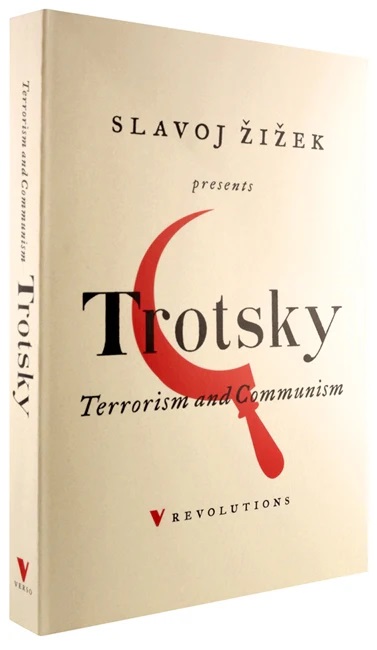
Terrorism and Communism by Leon Trotsky, with an incisive commentary by Slavoj Žižek, stands as a pivotal text in revolutionary literature, emerging from Russia’s Civil War. Written in 1920, Trotsky’s work is a fervent defence of the Bolshevik use of force and terror as essential instruments for the establishment and preservation of a socialist state. Confronting Karl Kautsky’s criticisms head-on, Trotsky dismisses the illusions of liberal democracy, advocating for the revolutionary dictatorship necessary to sustain the proletarian revolution.
Trotsky’s arguments are situated within the turbulent context of post-revolutionary Russia, a nation ravaged by war, famine, and internal strife. His defence of the Red Terror and the Cheka’s actions against counter-revolutionaries is presented not as a betrayal of socialist ideals, but as a pragmatic response to the existential threats facing the nascent Soviet state. Trotsky contends that the harsh measures, including the militarization of labour and centralized economic control, were imperative to prevent the collapse of the revolutionary government and to lay the groundwork for a future socialist society.
Žižek’s commentary amplifies the text’s contemporary relevance, arguing that Trotsky’s critique of Kautsky’s democratic socialism and his rejection of parliamentary democracy resonate with the current political climate. Žižek situates Trotsky’s work within a broader philosophical framework, examining the tensions between revolutionary necessity and ethical considerations. He provocatively suggests that Trotsky’s insights into the dynamics of power and violence challenge the complacency of modern liberal democracies, which often fail to address deep-seated structural inequalities.
In his foreword, Žižek dismantles the sanitized images of Trotsky propagated by later interpretations, both from libertarian Trotskyists and from his staunch critics. He highlights the complexity of Trotsky’s position, acknowledging the brutal realities of his strategies while emphasizing the critical difference between Trotsky’s revolutionary violence and the bureaucratic terror of Stalinism. Žižek’s analysis exposes the ideological underpinnings of Trotsky’s policies, arguing that his temporary embrace of authoritarian measures was a desperate yet necessary response to the dire conditions of revolutionary Russia.
Terrorism and Communism thus serves as a crucial document in understanding the dialectics of revolution. It challenges readers to consider the ethical and practical dimensions of revolutionary action, the role of violence in political transformation, and the tensions between short-term necessities and long-term ideals. Trotsky’s text, combined with Žižek’s penetrating commentary, invites a reevaluation of the moral imperatives and political strategies in the quest for social justice and radical change.
This edition is not merely a historical artifact but a living document that speaks to ongoing struggles against oppression and exploitation. It demands that contemporary readers confront the uncomfortable realities of revolutionary change and the sacrifices it entails. Terrorism and Communism is an essential read for those seeking to understand the complexities of revolutionary politics and the enduring relevance of Trotsky’s vision in a world still grappling with the legacy of class struggle and the pursuit of equality.
 Simon Gros
Leave a comment