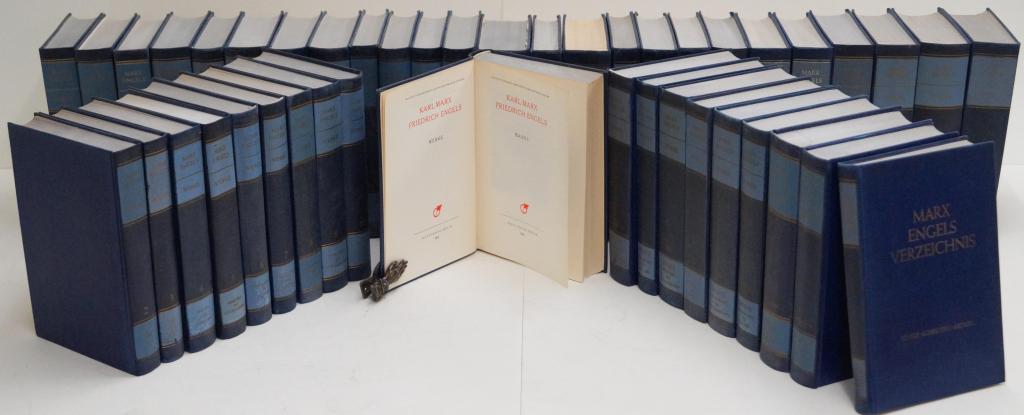
The Marx-Engels-Werke (MEW), often referred to as the Blue Volumes, is a comprehensive and widely cited German edition of the works of Karl Marx and Friedrich Engels. This monumental collection spans 44 volumes (in 46 books), initially published from 1956 onwards by the Institute for Marxism-Leninism at the Central Committee of the Socialist Unity Party of Germany (SED) for volumes 1–42, the Institute for the History of the Workers’ Movement for volume 43, and the Rosa Luxemburg Foundation for volume 44, under the Berlin-based Dietz Verlag. Since 1999, the Rosa Luxemburg Foundation has been the official publisher of the MEW.
Containing 1,700 writings and 4,170 letters, the MEW remains the most comprehensive edition of Marx and Engels’ literary legacy in the German language until the completion of the “Marx-Engels-Gesamtausgabe” (MEGA2). The high circulation and widespread distribution of the MEW are partly due to the fact that approximately 60% of the texts are in the original German, making this edition an invaluable resource for international translations and scholarly research.
The decision to publish a multi-volume German-language edition of Marx and Engels’ works was made by the Central Committee of the SED in 1953, marking the 70th anniversary of Karl Marx’s death. The German edition was explicitly based on the second Russian edition edited by the Institute for Marxism-Leninism at the Central Committee of the Communist Party of the Soviet Union in Moscow, which appeared between 1955 and 1966. The MEW adopted the division of volumes, selection of texts, and accompanying apparatus (prefaces, commentaries, indexes, etc.) from the Russian edition, but edited the texts based on the original manuscripts or translated them from the original languages into German.
The MEW is not a historically critical complete edition but rather a major study edition with a representative selection of texts. It includes all completed and published works, writings, and articles by Marx and Engels, a selection of manuscripts, drafts, and preliminary works, and finally, the letters of the two authors. Unlike the first and second MEGA editions, the MEW deliberately omits exhaustive publication of excerpts, rough drafts, sketches, and the presentation of texts in the original language.
The core volumes of the MEW appeared between 1956 and 1968, followed by two supplementary volumes (volumes 40 and 41) in 1967 and 1968, which included writings, manuscripts, and letters of Marx and Engels from before 1844. In 1983, a volume with Marx’s Grundrisse der Kritik der politischen Ökonomie (volume 42) was added, and in 1990 and 2018, two volumes with Marx’s economic manuscripts from 1861-1863 (volumes 43 and 44) were included. Additionally, the edition comprises two index volumes and a register volume.
The MEW had a significant impact on academic discussions of Marxism, particularly in West Germany during the Adenauer era and the Cold War, where possessing these volumes could sometimes lead to legal consequences. Oskar Negt reported the confiscation of ordered MEW volumes from East Germany by a West German court in 1960, which deemed them “state-threatening propaganda material” from the “Socialist Occupation Zone.”
Internationally, the MEW holds a special status in Marx-Engels research because much of its content is based on the original German manuscripts rather than translations from other languages. This status is shared only by the 50-volume English-language Marx/Engels Collected Works (MECW), where approximately 30% of the texts are in the original English. The volumes published until 1989 saw multiple reprints, with each volume selling over 60,000 copies. By the end of the German Democratic Republic (GDR), approximately 3.5 million MEW volumes had been printed, with about 1,500 copies per volume exported to over 30 countries, including 500-600 to Japan.
After the fall of the GDR, the publication of the MEW was halted but was resumed in 1999 when the PDS-affiliated Rosa Luxemburg Foundation took over the editorship. Since then, around a dozen volumes have been reprinted without changes, while other volumes have seen regular new editions with revised prefaces, annotations, chronologies, and person registers.
Structurally, the MEW does not have a designated division into sections as seen in the MEGA. Instead, the volumes are continuously numbered. However, the edition can be broadly categorized into three or four areas:
- Volumes 1-22 (Works and Articles): These volumes include well-known philosophical, economic, historical, and political works by Marx and Engels, such as “The German Ideology” (volume 3), “The Communist Manifesto” (volume 4), “The Eighteenth Brumaire of Louis Bonaparte” (volume 8), “Critique of the Gotha Program” (volume 19), and Engels’ “Anti-Dühring” (volume 20).
- Volumes 23-26.3 (Economic Writings): This section comprises Marx’s main work “Capital” (volumes 23-25) and “Theories of Surplus Value” (volumes 26.1-26.3), part of the economic manuscript from 1861-1863.
- Volumes 27-39 (Letters): These volumes contain the correspondence between Marx and Engels and their letters to third parties from 1842-1895.
- Volumes 40-44 (Supplementary Volumes): Volumes 40 and 41 supplement previously omitted material from before 1844, volume 42 includes the “Grundrisse” from 1857/58, and volumes 43 and 44 complete the economic manuscript from 1861-1863.
Additionally, two index volumes were published in 1966 and 1971, and a subject index for volumes 1-39 was released in 1989.
The Marx-Engels-Werke (MEW) represents an unparalleled academic and political endeavor, preserving and disseminating the works of two of the most influential thinkers in modern history. This edition remains a cornerstone for scholars and researchers, providing a rich, authoritative foundation for the study of Marxist theory and its historical development.
 Simon Gros
Leave a comment