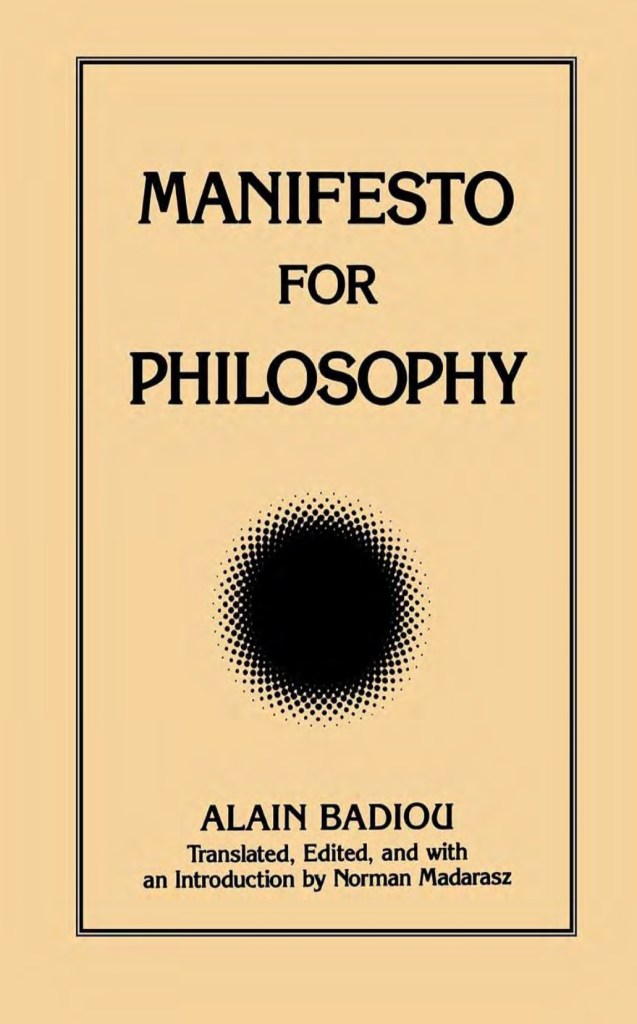
In Manifesto for Philosophy, Alain Badiou embarks on a formidable intellectual battle that challenges prevailing notions of philosophical demise in the modern era. Beginning with a provocative question—whether philosophy lies dead amidst the ruins of past certainties—Badiou confronts the aftermath of monumental philosophical earthquakes, from Nietzsche’s proclamation of God’s death to the deconstruction of the subject and the disqualification of Truth itself.
The specter of WWII, with its unfathomable horrors and the unsettling complicity of philosophers like Heidegger, casts a profound shadow. Badiou contends that philosophers, uniquely burdened with the century’s anguish, have both shouldered guilt and sought redemption in a renewed philosophical enterprise. The central dilemma emerges: to either succumb to the grandiosity of all-encompassing philosophical ambitions, risking annihilation, or adopt a humbler stance conducive to genuine possibility.
Drawing upon Plato’s enduring insights, Badiou posits a framework organized around four conditions of truth: the scientific-mathematical, the artistic-poetic, political inventions, and love. Of particular significance is love, which offers a singular pathway to truth through its intrinsic subjectivity—a notion that echoes Descartes’ foundational inquiry into the self. Here, Badiou finds resonance with Lacan’s psychoanalytic depth, viewing a renaissance of philosophy as contingent upon a synthesis with Lacanian thought.
Central to Badiou’s thesis is the urgent reinstatement of truth as a philosophical imperative. Truth, he argues, lies at the core of human existence, paradoxically rooted in impossibility—a gap, an unconscious yearning that defines the very essence of philosophical pursuit. This insistence on truth’s necessity constitutes both a formidable challenge and an essential task for contemporary thought.
Manifesto for Philosophy has been lauded as a pivotal work by one of today’s foremost philosophers, poised to invigorate discourse grown complacent with its own obituary. Badiou’s text unfolds as a manifesto and an excavation, probing the depths of philosophical inquiry to reclaim, redefine, and renew its relevance in a world grappling with its own existential quandaries.
From Hegel’s meditations on truth’s complexity to contemporary mathematical inquiries into the undecidable, Badiou traverses vast intellectual terrain. He navigates the turbulent waters of relativity and boundary-crossing frontiers, where philosophy confronts its perpetual quest for truth—its modes of expression, its languages, and its very means of transmission. In these explorations, Badiou elucidates not only the philosophical event but also its profound implications for ontology and the nature of human understanding.
Manifesto for Philosophy, originally published in 1989 as Manifeste pour la philosophie, stands as a seminal work in Badiou’s oeuvre, now translated into English for wider dissemination. It offers multiple points of entry into Badiou’s expansive philosophical framework, characterized by a rigorous rationalism that intertwines intervention at the site of the event with a profound engagement with the void from which every philosophical act emerges. As Badiou contends, every act of philosophy is, at its core, a decision concerning the event—an unpredictable eruption that reshapes and challenges our intellectual landscape perpetually.
Manifesto for Philosophy heralds a resurgence—a call to arms amidst philosophical introspection and societal turmoil—a testament to Badiou’s enduring commitment to the transformative power of rigorous thought in shaping our collective understanding of truth and existence.
 Simon Gros
Leave a comment