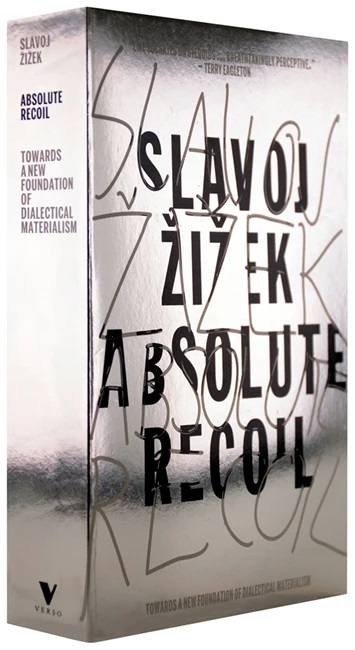
In Absolute Recoil, Slavoj Žižek developed an ambitious philosophical project to redefine the contours of materialist thought in light of contemporary scientific and ideological challenges. The book is an audacious re-examination of dialectical materialism, which Žižek contends must evolve to account for the radical shifts in our understanding of reality brought about by quantum physics, relativity theory, and psychoanalysis, as well as the political failures of the twentieth century. This work challenges the limitations of previous materialist frameworks, including those of Lenin and Althusser, proposing a revitalized dialectical materialism that embraces Hegelian and Lacanian insights.
Žižek’s philosophical journey begins with a critical reassessment of the materialist tradition. He argues that the materialist worldview has stagnated, failing to incorporate the profound implications of modern scientific discoveries and the revolutionary implications of psychoanalytic theory. Lenin’s assertion that materialism must evolve with scientific advances is extended by Žižek to critique Lenin’s own materialist framework, which he believes inadequately addresses the complexities revealed by relativity and quantum mechanics. This critique is not only a historical exercise but a plea for a radical transformation in the way we conceptualize materialism.
At the heart of Žižek’s argument is the notion that dialectical materialism, when properly reconfigured, offers the most robust philosophical response to contemporary challenges. He positions dialectical materialism as the philosophical heir to Hegel’s “speculative” approach, one that is uniquely equipped to grapple with the contradictions and inconsistencies of modern reality. Žižek asserts that the failures of actually existing Communism and the inadequacies of contemporary materialist theories—from scientific naturalism to Deleuzian New Materialism—underscore the necessity of revisiting and reinterpreting Hegelian dialectics.
In Absolute Recoil, Žižek elaborates on his vision for a renewed dialectical materialism through the interstices of philosophical analysis, cultural critique, and speculative metaphysics. The book is structured around three central themes: the transformation of Kantian transcendentalism into Hegelian dialectics, the exploration of Hegel’s Absolute, and the attempt to think beyond Hegelian constraints.
Žižek’s exploration of Kantian transcendentalism versus Hegelian dialectics focuses on the shift from Kant’s idealist framework to Hegel’s dynamic and dialectical approach. He argues that Hegel’s dialectical method, which embraces contradiction and conflict as intrinsic to the development of knowledge and reality, offers a more adequate framework for understanding the nature of existence. This dialectical approach is contrasted with what Žižek terms “vulgar democratic materialism,” which he criticizes for failing to account for the fundamental inconsistencies and antagonisms of reality.
The examination of Hegel’s Absolute is a key component of Žižek’s argument. He looks at the complexities of Hegel’s concept of Absolute Knowing and the notion of the Absolute as an evental process rather than a static, fully realized entity. Žižek challenges traditional interpretations of Hegel as an idealist who seeks to reconcile all contradictions, instead presenting Hegel as a thinker who reveals the inherent instability and dynamism of reality. This interpretation leads to a radical rethinking of materialism as not merely a critique of idealism but as an engagement with the contradictory and self-sublating nature of existence.
In his attempt to move beyond Hegel, Žižek introduces the concept of “less than nothing,” drawing on insights from quantum physics to argue that reality is fundamentally inconsistent and antagonistic. He critiques the idea that reality can be understood as a stable, harmonious system, positing instead that the very notion of stability is a phantasmatic construction. This leads to a redefinition of materialism that acknowledges the materiality of the ideal order itself and embraces the radical incompleteness and contingency of existence.
Throughout Absolute Recoil, Žižek engages with a diverse array of cultural and artistic examples, from Arnold Schoenberg’s music to the films of Ernst Lubitsch, to illustrate his philosophical points. These interludes serve to enrich his theoretical arguments with concrete instances of how dialectical materialism can illuminate and be illuminated by various forms of artistic and cultural expression.
The book’s dense and complex structure reflects its ambitious scope. It interlocks precise philosophical arguments with references to literature, music, psychoanalysis, and politics. Žižek’s approach, while occasionally disorienting, provides a rich variety of insights into the nature of reality and the possibilities of materialist philosophy.
Absolute Recoil represents a challenging contribution to contemporary philosophy. Žižek’s reimagining of dialectical materialism offers a bold response to the inadequacies of existing materialist theories, proposing a framework that embraces the contradictions and complexities of modern existence. This work demands careful and critical engagement from readers, inviting them to reconsider fundamental assumptions about reality, knowledge, and the nature of materialism itself.
 Simon Gros
Leave a comment