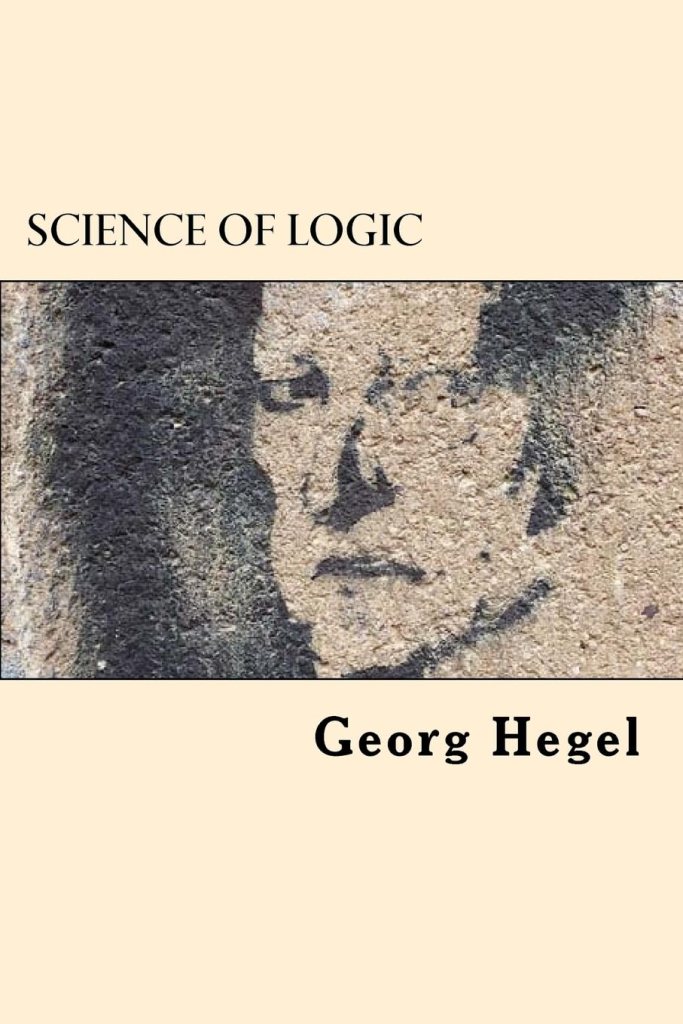
Science of Logic by Georg Wilhelm Friedrich Hegel stands as an indispensable cornerstone in the edifice of Western philosophy. Published in stages from 1812 to 1816, this monumental work is Hegel’s exhaustive exposition of his dialectical method, a revolutionary system that posits the unity of thought and being as a dynamic and evolving whole.
Hegel’s logic transcends the traditional Aristotelian framework, reinterpreting syllogistic reasoning as an organic phase within the original unity of thought and being. For Hegel, this unity signifies that reality is intrinsically rational, and thus, the structures of thought are fundamentally aligned with the structures of reality. Logic, in this context, is not a mere tool for formal inference but the very foundation of the rational structure of all existence.
Hegel’s dialectics reveal the self-developing nature of concepts, encompassing an array of existential categories such as being, nothingness, becoming, existence, reality, essence, reflection, and concept. This logical progression illustrates how contradictions inherent in concepts resolve and transform into higher orders of understanding, culminating in an ever-evolving comprehension of the Absolute.
Science of Logic is thus not just a treatise on logical theory but a profound inquiry into the metaphysical substratum of all phenomena. It asserts that the true nature of the world can only be comprehended through a rigorous, dialectical method that unveils the rational essence underlying all reality. This method, embodying the movement of the Notion, represents the core of Hegelian philosophy: the process by which thought and being achieve their fullest expression and unity.
The influence of Hegel’s logic extends far beyond its immediate intellectual milieu, impacting various schools of contemporary philosophy. From Marxist materialism to Existentialist phenomenology, reactions to Hegelianism are pivotal in shaping modern philosophical discourse. Understanding Hegel’s Science of Logic is thus crucial for grasping the development and trajectory of subsequent philosophical thought.
In its continued relevance, Hegel’s work compels philosophers to confront the implications of a system where reality and rationality are inextricably linked. It remains a crucial text for those who seek to delve into the depths of speculative philosophy, challenging them to engage with the dialectical process that lies at the heart of Hegelian logic.
 Simon Gros
Leave a comment