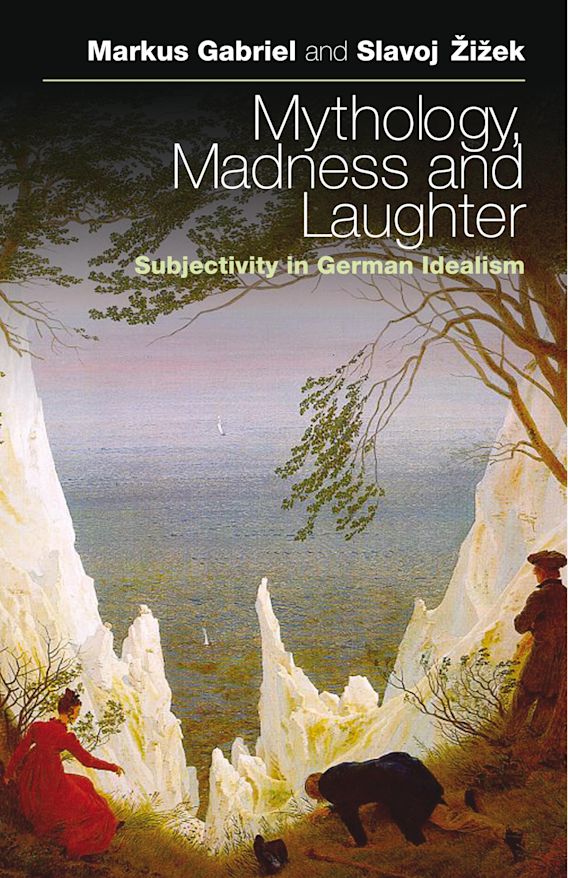
Mythology, Madness, and Laughter by Slavoj Žižek and Markus Gabriel, presents a dense and provocative examination of German idealism, engaging deeply with themes that are both central and often overlooked within this philosophical tradition. Žižek, renowned for his eclectic blend of Lacanian psychoanalysis, cultural critique, and philosophical rigor, alongside Gabriel, one of contemporary philosophy’s most promising voices, navigate through the intricate terrain of German idealism to illuminate its enduring relevance and profound insights into the nature of subjectivity and truth.
The authors focus primarily on three pivotal figures: Hegel, Schelling, and Fichte. They analyse how these thinkers grapple with the tension between being and appearance, the challenges of reflection in relation to the absolute, and the intricate dynamics between insight and ideology, as well as contingency and necessity. Central to their inquiry is the question of how Being can manifest in reflection without reverting to traditional metaphysical frameworks—a question that pushes the boundaries of philosophical thought and underscores the originality and radical potential of post-Kantian idealism.
In their analysis, Gabriel and Žižek argue that German post-Kantian idealism initiates a fundamental shift from an epistemological focus to a new form of ontology. This shift involves integrating the concepts of error, illusion, and contradiction into the very essence of truth and reality. By situating the gap between the absolute (noumenal) and the relative (phenomenal) within the absolute itself, they propose a revolutionary understanding of freedom and necessity. This perspective challenges the reader to reconsider the conventional dichotomies that have long shaped philosophical inquiry.
One of the book’s core arguments is that the process of truth emerging from the denouncement of illusion is not merely an epistemological concern but an ontological reality intrinsic to the noumenal world. For Hegel, Schelling, and Fichte, the errors and contradictions in our knowledge are not obstacles to be overcome but essential elements that constitute the reality they aim to describe. This Hegelian insight, that our incomplete and often erroneous understanding of things reflects a deeper truth about the nature of those things, forms a cornerstone of Gabriel and Žižek’s argument.
The exploration of madness and everydayness, particularly in Hegelian philosophy, serves as a crucial point of entry into the broader discussion of subjectivity and freedom. By examining how Hegel addresses the extremes of human experience—madness representing the breakdown of rationality and everydayness signifying the mundane routine—Žižek and Gabriel illustrate the dynamic and often paradoxical nature of subjectivity. They argue that these extreme states are not external to the rational subject but are integral to understanding the full scope of human existence.
Mythology, Madness, and Laughter contends that freedom, in the context of post-Kantian idealism, transcends its Kantian roots. While Kant posited freedom as an inexplicable ‘fact of reason,’ something external to the noumenal and phenomenal realms, German idealists reframe freedom as an inherent feature of being itself. For Fichte, Schelling, and Hegel, freedom is not opposed to necessity but is an essential aspect of the self-determining process of reality. This shift has profound implications for contemporary philosophy, as it challenges the notion of an external absolute and emphasizes the self-othering nature of the absolute within the finite world.
The authors argue that post-Kantian idealism, especially as articulated by Hegel, should not be seen as a regression to pre-critical metaphysics but as a radicalization of Kant’s critical project. By dissolving the traditional hierarchy of substance and accident, they show that the apparent inconsistencies and errors in our understanding are not merely epistemological shortcomings but ontological conditions of the reality they seek to comprehend. This inversion of the traditional metaphysical framework reveals a dynamic and self-negating absolute that can only be understood through its contingent manifestations.
Gabriel and Žižek’s work is a call to contemporary philosophy to embrace the complexities and contradictions inherent in existence. They argue that German idealism offers profound insights into the nature of subjectivity, truth, and freedom that remain highly relevant today. By reasserting the importance of these thinkers, Mythology, Madness, and Laughter challenges readers to engage deeply with the legacies of Hegel, Schelling, and Fichte and to rethink the foundational assumptions of philosophical inquiry.
This book is a rigorous and thought-provoking examination of post-Kantian idealism. It presents a compelling case for the ongoing relevance of Hegel, Schelling, and Fichte in contemporary philosophical debates and offers a rich and nuanced understanding of subjectivity, truth, and freedom. Through their erudite and insightful analysis, Žižek and Gabriel invite readers to reconsider the nature of reality and the role of philosophy in illuminating its complexities.
 Simon Gros
Leave a comment