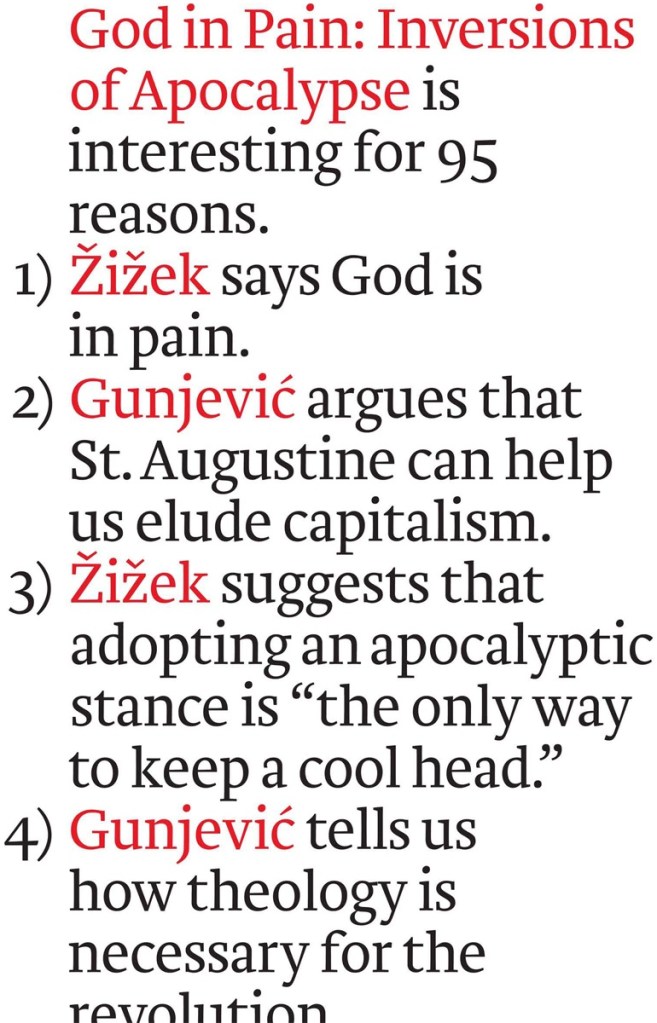
In God in Pain Slavoj Žižek and Croatian philosopher Boris Gunjević engage in a bold and challenging re-examination of the major monotheistic religions through the sophisticated lenses of Hegelian and Lacanian analysis. This intellectually audacious work dissects Christianity, Islam, and Judaism, unsettling the ways these traditions conceptualize divinity, suffering, and humanity, and examining the implications for contemporary existential and ethical dilemmas.
Slavoj Žižek delves into Christianity, Islam, and the relationship between suffering and salvation. His analysis is marked by the critical and often provocative style for which he is renowned. In his chapter Christianity Against Sacred Žižek presents Christianity as a radical inversion of traditional sacredness, arguing that its core principles challenge and subvert the very concept of the sacred. His exploration of Islam in Glance into the Archives of Islam presents a novel interpretation that upends conventional readings and exposes hidden dimensions of Islamic faith. In Only Suffering God Can Save Us, he probes the concept of divine suffering, suggesting that it is central to understanding salvation and redemption. And in Animal Gaze he interrogates the intersection of animality and divinity, revealing how non-human perspectives can transform religious thought. Lastly, For the Theologico-Political Suspension of the Ethical advocates for the suspension of traditional ethical frameworks in the face of theological insights, proposing a radical rethinking of ethical norms.
Boris Gunjević complements Žižek’s analyses with his own rigorous philosophical reflections. In Mistagogy of Revolution, Gunjević examines how revolutionary movements reinterpret religious doctrines to justify radical transformations, shedding light on the often concealed interplay between ideology and faith. Virtues of Empire explores the complex relationship between imperial power and religious virtue, analysing how imperial contexts reshape religious values. His chapter Every Book Is Like Fortress investigates the sacred texts of the Abrahamic faiths as ideological fortresses, providing a critical perspective on their role in maintaining or challenging religious orthodoxy. In Radical Orthodoxy, Gunjević engages with contemporary theological thought, critiquing its tendency towards dogmatic rigidity and advocating for a more flexible approach. Finally, Prayer and Wake explores the significance of ritual and prayer in sustaining or disrupting religious structures, offering a nuanced view of their role in faith practices.
Together, Žižek and Gunjević’s work challenges readers to reconsider their assumptions about faith, ethics, and the nature of divine authority. Their discussions not only interrogate the core tenets of the world’s major religions but also tackle contemporary issues such as secularism, fundamentalism, and the role of religion in public life. The book stands as a daring philosophical exploration, pushing the boundaries of traditional religious thought and offering a compelling critique of how ancient systems of belief continue to shape and distort modern existence.
In God in Pain: Inversions of Apocalypse, Žižek and Gunjevic deliver a thought-provoking and daring critique of major monotheistic religions, inviting readers to engage with the often unsettling implications of their analyses.
 Simon Gros
Leave a comment