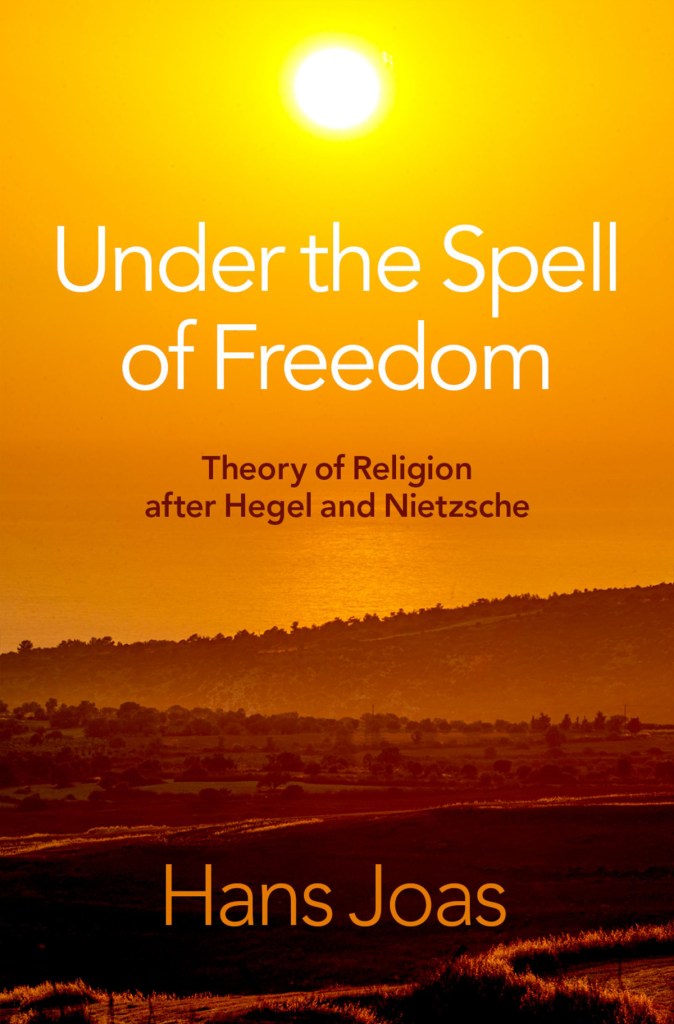
Under the Spell of Freedom by Hans Joas is an exploration that delves into the complex interplay between the histories of religion and political freedom. Joas navigates through the broad and often confusing array of perspectives that have emerged within philosophy, the humanities, social sciences, and public discourse. At the heart of this intricate analysis lies the enduring influence of Hegel’s grand synthesis, which harmonized Christianity with the concept of political freedom, a framework that continues to serve as a significant point of orientation for many, even amidst the radical provocations posed by Friedrich Nietzsche.
Joas proposes that the twentieth century witnessed the development of a distinctive perspective within religious thought, one that embraces a more open-ended view of history and a more profound conception of freedom than that articulated by Hegel. By examining sixteen pivotal thinkers, Joas deconstructs the Hegelian narrative of history as the progressive realization of freedom, instead presenting a counter-narrative that highlights the emergence of moral universalism. This analysis is set against the backdrop of the starkly contrasting views of Hegel, who emphasized the central role of Protestant Christianity, and Nietzsche, who vehemently criticized Christianity and rejected modern liberal democracy.
In this book, Joas offers a forceful argument for a global history of moral universalism, challenging the Eurocentric and intellectualist biases that have often dominated discussions on religion and freedom. He draws on the intellectual legacies of influential figures such as Ernst Troeltsch, Paul Tillich, H. Richard Niebuhr, Paul Ricœur, David Martin, and Robert Bellah, among others, to illuminate an alternative intellectual tradition that diverges significantly from Hegelian and Nietzschean paradigms. This tradition, according to Joas, is characterized by a richer, more nuanced understanding of freedom and its implications for religious faith and practice.
Joas’s exploration is not just a critique but an ambitious attempt to synthesize these varied intellectual contributions into a coherent narrative that underscores the vitality and relevance of their ideas. He argues that the developments in the theory of religion over the past century cannot be adequately understood without considering their intersection with the normative demands and the history of political freedom. This approach necessitates a departure from the traditional confines of disciplinary boundaries, advocating for an interdisciplinary framework that can more effectively capture the complexities of these discussions.
The book is structured around an exploration of these thinkers and their contributions, which Joas likens to a novella cycle rather than a straightforward collection of essays or a monograph. This structure allows for a holistic view that respects the individuality and historical context of each thinker’s work while weaving them into a broader narrative. Joas contends that this method highlights the interconnectedness and mutual influences among these thinkers, offering a more dynamic and integrated understanding of their contributions.
Joas sets the stage for this intellectual journey by outlining the limitations of Hegelian and Nietzschean thought and articulating the need for an alternative perspective. He discusses the influence of American pragmatism and his previous work on the genesis of values, human rights, and the power of the sacred, framing these as foundational to his current project. Joas also acknowledges the interdisciplinary and interdenominational character of the intellectual tradition he seeks to present, emphasizing its relevance in overcoming Eurocentric perspectives and addressing global challenges.
Joas’s engagement with contemporary scholars, such as Axel Honneth and Charles Taylor, further enriches the discourse, situating his arguments within current debates on justice, autonomy, and modern values. By critically examining these perspectives, Joas not only clarifies his position but also contributes to the ongoing dialogue on the role of freedom in shaping modern ethical ideals.
Under the Spell of Freedom is thus an essential work for scholars and students of religion, philosophy, and social theory. It offers a fresh and exciting contribution to the field, urging readers to reconsider the foundational premises of Western philosophical traditions and to embrace a more inclusive and forward-looking vision of the relationship between religion and freedom. Through meticulous scholarship and insightful analysis, Joas challenges us to rethink entrenched views and envision a future where moral universalism and freedom are intricately intertwined in ways that transcend conventional boundaries, offering new possibilities for understanding and engagement in a globalized world.
 Simon Gros
Leave a comment