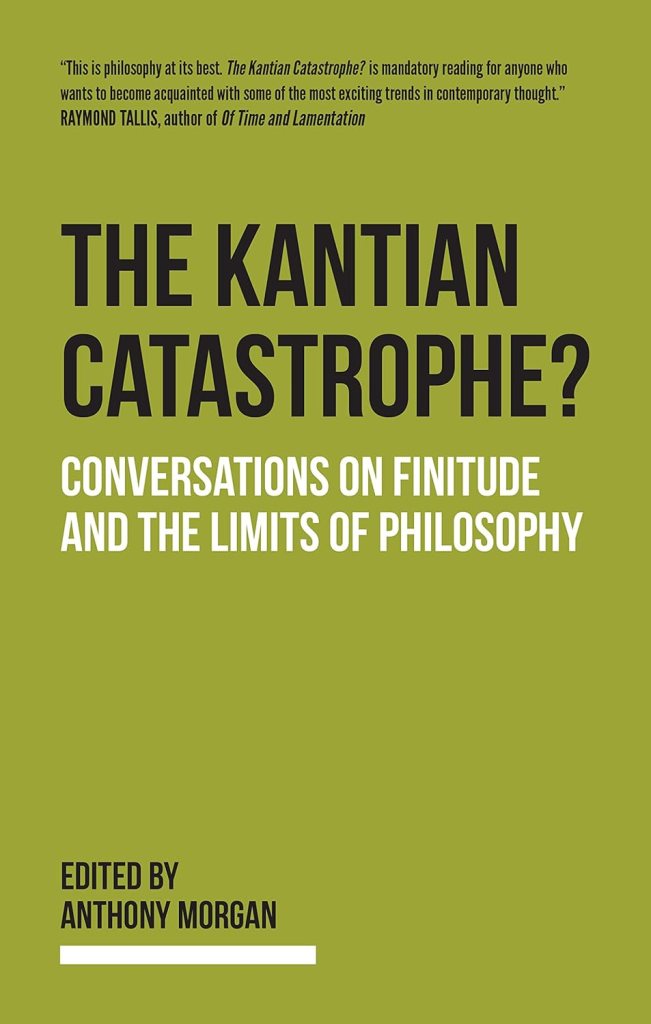
The Kantian Catastrophe? by Anthony Morgan is a multifaceted exploration of Immanuel Kant’s lasting impact on modern philosophy. Kant, often regarded as the most influential philosopher of the modern era, revolutionized the field by positioning the finitude of the human subject at the center of philosophical inquiry and asserting the inaccessibility of reality in itself. This transformation, famously referred to as the “Copernican revolution” in philosophy, set strict boundaries on metaphysical pursuits, leading to significant existential and epistemological repercussions. The radical nature of Kant’s philosophy has been both celebrated and critiqued, with its effects described as a “Kantian catastrophe” by contemporary philosopher Quentin Meillassoux.
Morgan’s collection comprises a series of insightful and accessible interviews with fifteen distinguished philosophers, including Lucy Allais, A.W. Moore, Stella Sandford, Stephen Mulhall, Joseph Schear, Beatrice Han-Pile, Tom Sparrow, Marie-Eve Morin, Bruno Bosteels, Adrian Johnston, Simon O’Sullivan, John Ó Maoilearca, Catherine Malabou, Graham Harman, and Ray Brassier. These dialogues delve deeply into the heart of contemporary debates surrounding Kant’s philosophical legacy, offering a comprehensive and varied examination of how Kant’s critical philosophy continues to influence and challenge modern thought.
The book begins with an introduction that sets the stage for the ensuing discussions by outlining the dual nature of Kant’s impact: his revolutionary redefinition of philosophy that placed inherent limits on human cognition, and the resulting tension between those limits and the philosophical drive to transcend them. This duality is encapsulated in the book’s title, which poses a question about whether Kant’s legacy is indeed catastrophic or whether it provides a necessary framework for philosophical inquiry.
Morgan’s interviews cover a wide range of topics related to Kant’s philosophy, including the distinction between phenomena and noumena, the role of the transcendental, and the implications of Kant’s ideas for contemporary philosophical movements such as speculative realism. For instance, Catherine Malabou discusses the transcendental as the non-empirical origin of thinking, while Graham Harman explores the idea of the thing-in-itself and its relation to phenomena. These conversations reveal the diverse ways in which Kant’s philosophy has been interpreted, appropriated, and contested by modern thinkers.
A central theme of the book is the exploration of Kant’s doctrine of finitude. As Morgan and his interviewees discuss, Kant’s emphasis on the limits of human knowledge and the bounded nature of our cognitive faculties has had profound implications for how we understand ourselves and our place in the world. Stephen Mulhall, for example, reflects on the human tendency to view limits as limitations and the resulting desire to transcend our finite condition. This theme resonates throughout the book, highlighting the ongoing struggle within philosophy to reconcile the acceptance of human finitude with the aspiration for greater understanding and transcendence.
Another significant aspect of the book is its examination of the so-called “Kantian catastrophe.” Meillassoux’s critique of Kant centers on the idea that Kant’s critical philosophy has confined us within the bounds of human cognition, cutting us off from the “great outdoors” of absolute reality. Morgan’s interviews probe this notion, questioning whether Kant’s restriction on metaphysical knowledge is indeed a catastrophic limitation or a necessary corrective to philosophical overreach. This debate is vividly illustrated in the contrasting views of the interviewees, who offer both defenses and critiques of Kant’s legacy.
For example, Adrian Johnston discusses the ramifications of Kant’s ideas for our understanding of subjectivity and nature, while Beatrice Han-Pile examines the paradoxical nature of Kant’s philosophy, which positions humanity as both the constitutor of experience and an object within it. These discussions underscore the complex and often contentious nature of Kant’s influence on modern philosophy, revealing both the depth of his impact and the diversity of responses it has elicited.
Morgan’s skilful questioning and the candid, often provocative responses from his interlocutors make The Kantian Catastrophe? an engaging and thought-provoking read. The book not only provides a thorough overview of current Kantian scholarship but also invites readers to reflect on the broader implications of Kant’s philosophy for contemporary thought. By addressing the enduring questions and challenges posed by Kant’s critical philosophy, Morgan’s collection offers valuable insights into the ongoing dialogue between Kantian and post-Kantian perspectives.
In sum, The Kantian Catastrophe? Conversations on Finitude and the Limits of Philosophy is an essential resource for anyone interested in the enduring legacy of Immanuel Kant. Through its rich and varied interviews, the book illuminates the profound impact of Kant’s ideas on modern philosophy and offers a comprehensive and nuanced exploration of the challenges and possibilities they present. Whether you are a seasoned scholar or a curious newcomer to Kantian thought, this collection provides a compelling and accessible entry point into the complex and fascinating world of Kantian and post-Kantian philosophy.
 Simon Gros
Leave a comment