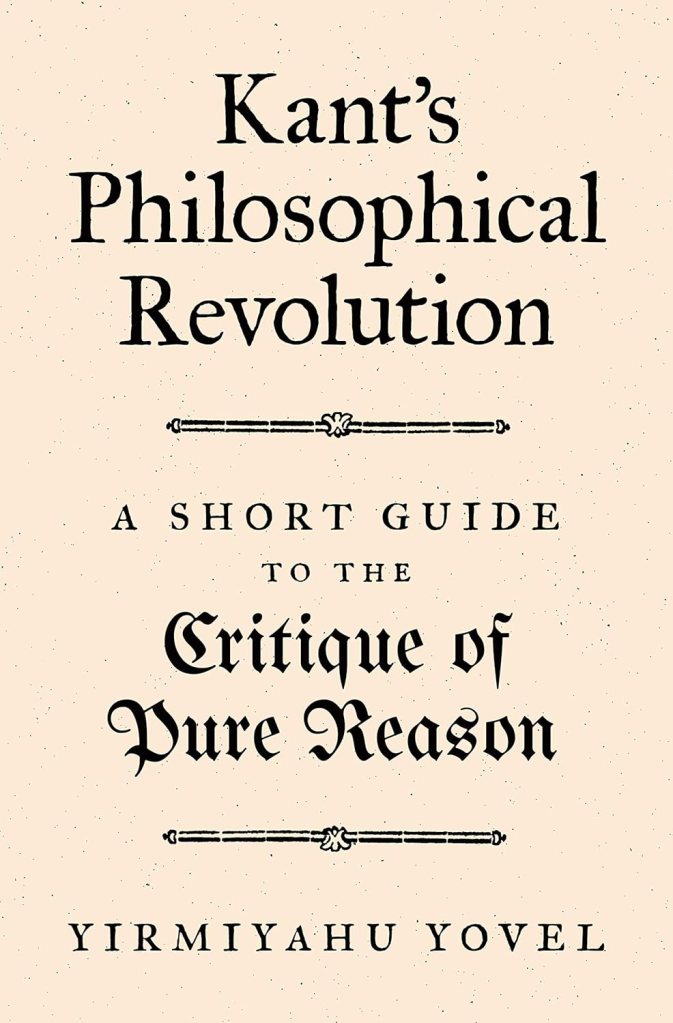
In Kant’s Philosophical Revolution, Yirmiyahu Yovel presents a deeply insightful and authoritative commentary on one of the most formidable texts in modern philosophy. Immanuel Kant’s Critique of Pure Reason is a landmark work that radically reshaped the landscape of epistemology and metaphysics, yet its dense arguments and complex prose often pose significant challenges to readers. Yovel’s guide stands as a guide for navigating this web of philosophical thought, offering a clear, systematic, and accessible exposition of Kant’s revolutionary ideas.
Kant’s Critique of Pure Reason is distinguished by its bold assertion that the structure of human knowledge fundamentally shapes our experience of reality. This “Copernican turn” in philosophy asserts that rather than our knowledge conforming to an objective reality that exists independently of us, reality itself is constituted by the cognitive structures of the human mind. Yovel outlines how this paradigm shift transforms our understanding of objects and objectivity. He elucidates Kant’s argument that empirical objects are not pre-existing entities waiting to be discovered but are instead constructed through the active synthesis of sensory data and a priori concepts.
Yovel’s guide distills Kant’s complex arguments into a coherent narrative, starting with the foundational observations that underpin the Critique. He explains Kant’s revolutionary rethinking of the object as dependent on the cognitive faculties rather than existing independently. This transformation has profound implications for the philosophy of science and metaphysics, as Yovel shows how Kant’s critique addresses the epistemological limits of human reason and the foundations of scientific knowledge.
A major contribution of Yovel’s commentary is its clarity in explaining Kant’s intricate concepts. The guide provides accessible interpretations of Kant’s discussions on transcendental logic, including the roles of space and time as forms of intuition, the function and validity of categories, and the process of synthesis through judgment. Yovel demystifies Kant’s technical language and complex arguments, such as the distinctions between general and transcendental logic and the various forms of the Transcendental Deduction, making them approachable for both newcomers and seasoned readers.
Furthermore, Yovel explores Kant’s critique of metaphysics and his argument for the finitude of human reason. He articulates Kant’s position that reason, while powerful in its scope, is inherently limited and that these limitations are crucial for establishing a rigorous and systematic philosophy. This dual aspect of Kant’s critique—affirming reason’s capabilities while acknowledging its constraints—is central to understanding Kant’s philosophical project.
Yovel’s guide also highlights the connections between the Critique and Kant’s other writings, shedding light on how Kant’s ideas in the Critique relate to his moral philosophy, political thought, and subsequent philosophical work. This contextualization not only enriches the reader’s comprehension of Kant’s ideas but also demonstrates the broader impact of Kant’s revolutionary thought on the trajectory of modern philosophy.
The book’s organization is designed to guide readers through Kant’s dense text with clarity and precision. Yovel’s systematic approach breaks down Kant’s arguments into digestible sections, offering detailed explanations of pivotal concepts such as the “I think,” the nature of transcendental aesthetics, and the role of empirical and pure concepts in shaping our understanding of the world. Each chapter builds on the previous one, ensuring that readers gain a comprehensive understanding of Kant’s philosophical system.
Acclaimed for its intellectual rigor and readability, Yovel’s guide serves as an invaluable resource for students, scholars, and anyone interested in Kantian philosophy. By making Kant’s challenging text more accessible and illuminating its profound insights, Kant’s Philosophical Revolution stands as a crucial tool for engaging with one of philosophy’s most transformative works.
 Simon Gros
Leave a comment