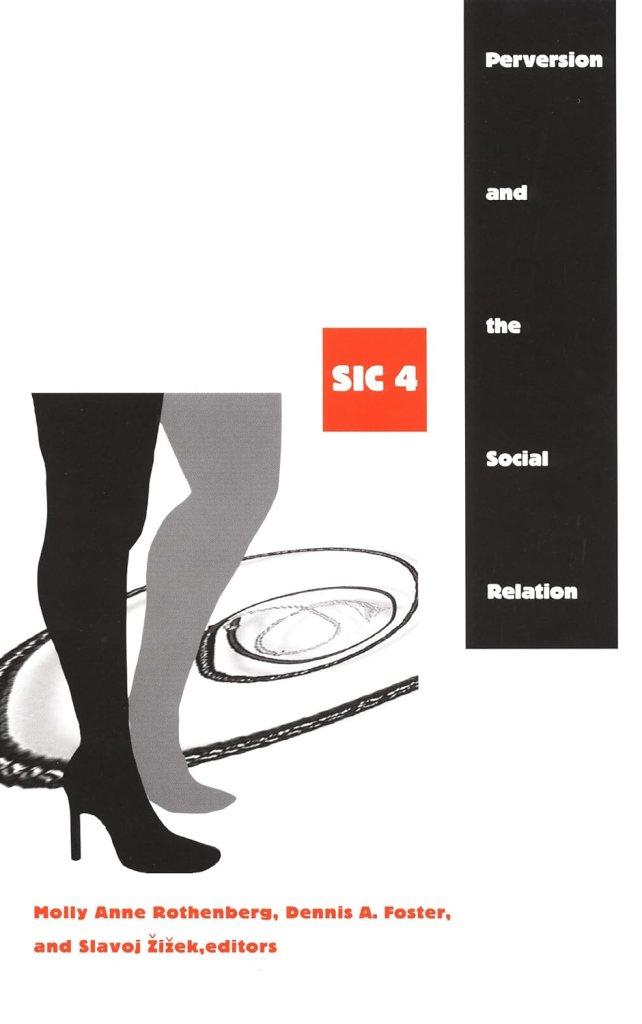
Perversion and the Social Relation by Molly Anne Rothenberg, Slavoj Žižek, and Dennis A. Foster delves deeply into the intricate and often misunderstood role that perversion plays in the formation and sustenance of social relations. This anthology argues against the traditional stigmatization of perversion, positing it as a crucial stage in the psychic development of non-psychotic subjects. The editors and contributors collectively suggest that understanding perversion is essential for comprehending how individuals relate to one another within societal structures.
The book begins by challenging the classical Oedipal model of maturation and desire, which has long dominated psychoanalytic and social theory. According to Freud’s theory, the resolution of the Oedipus complex is essential for the development of a mature social subject. However, Rothenberg, Žižek, and Foster argue that this model is insufficient for explaining the complexities of contemporary social relations. Instead, they propose that perversion, often seen as deviant or pathological, should be recognized as a fundamental psychic structure that persists in the adult psyche and influences social interactions.
Central to this argument is the redefinition of perversion from a series of aberrant behaviours to a necessary psychic mechanism that facilitates social cohesion and transformation. Perversion is not merely about taboo or forbidden acts; it encompasses a broader range of desires and behaviours that challenge and redefine social norms. By focusing on perversion as a structure of the psyche, the contributors provide a new framework for analysing social relations, one that moves beyond the limitations of the Oedipal model.
The book is divided into several essays, each examining different aspects and manifestations of perversion. Žižek’s contribution, for instance, explores the politics of masochism as depicted in David Fincher’s movie Fight Club. He argues that masochism, far from being merely a personal kink, reveals deeper truths about social and political subjection. Similarly, other essays analyse perversion through various cultural texts, such as William Styron’s The Confessions of Nat Turner, Don DeLillo’s White Noise, and William Burroughs’s Cities of the Red Night. These analyses demonstrate how perverse desires and behaviours are not only individual phenomena but are also deeply embedded in cultural and social practices.
The contributors draw on a wide range of psychoanalytic perspectives, primarily Freudian and Lacanian, to support their arguments. They also incorporate insights from anthropology, history, literature, and film studies, creating a rich interdisciplinary dialogue. This approach allows for a more nuanced understanding of how perversion operates within different contexts and how it contributes to the formation of social bonds.
One of the key themes of the book is the idea that perversion, while often leading to personal suffering, is also a source of social pleasure and cohesion. The editors argue that perversion provides a necessary substitute for the Father figure, whose authority is both invoked and subverted by perverse acts and desires. This dynamic creates a complex interplay between pleasure, power, and social regulation. By disavowing the limitations imposed by the Father (or the law), the pervert simultaneously challenges and reinforces the structures of social order.
The book does not shy away from the darker aspects of perversion. It acknowledges that fixation at the stage of the perverse can result in significant suffering for both the individual and those around them. However, it also contends that perversion is a driving force behind many social relations, offering both a source of pleasure and a mechanism for social change. This dual aspect of perversion—as both disruptive and foundational—is a central focus of the book.
Contributors to the volume include renowned scholars such as Michael P. Bibler, Bruce Fink, Octave Mannoni, E. L. McCallum, James Penney, Nina Schwartz, and the editors themselves. Each brings a unique perspective to the study of perversion, enriching the discussion with diverse theoretical and methodological approaches.
Perversion and the Social Relation provides a ground-breaking re-evaluation of the role of perversion in social life. By reframing perversion as a fundamental psychic structure rather than mere deviant behaviour, the book opens up new avenues for understanding how social relations are formed, maintained, and transformed. It is an essential read for scholars and students of psychoanalysis, cultural studies, and social theory, offering a comprehensive and thought-provoking analysis of the perverse foundations of social life.
 Simon Gros
Leave a comment