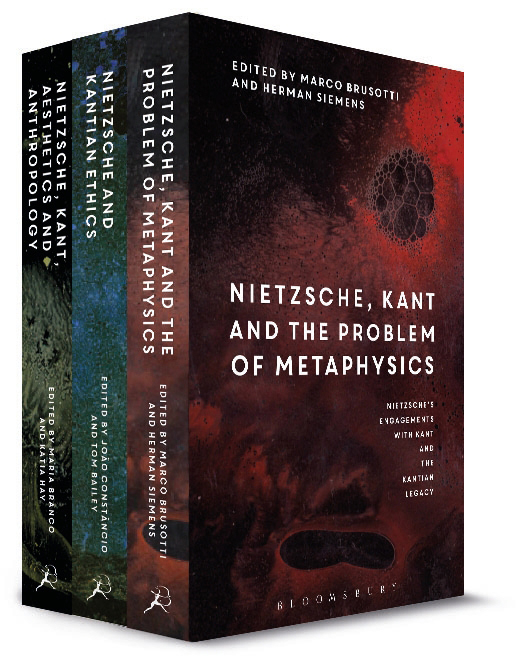
This collection offers an analysis of the relationship between Friedrich Nietzsche and Immanuel Kant, two monumental figures in modern European philosophy. Edited by a distinguished team comprising Marco Brusotti, Herman Siemens, João Constâncio, Tom Bailey, Maria João Mayer Branco, and Katia Hay, this three-volume series delves into Nietzsche’s nuanced and critical interactions with Kant’s legacy, investigating how Nietzsche’s philosophy both aligns with and diverges from Kantian thought.
The collection brings together an international cohort of seasoned Nietzsche scholars and emerging researchers, who have also extensively studied Kant. Their collective work traverses the rich landscape of Nietzsche’s philosophical dialogues with Kantianism, asserting that Nietzsche’s thought can be best understood as operating both ‘with and against’ Kant. This multifaceted approach forms the crux of the volumes, examining Nietzsche’s explicit references to Kant, his responses to Kantian theorists, and the broader philosophical debates that these interactions inspire.
Volume I, Nietzsche, Kant and the Problem of Metaphysics, edited by Marco Brusotti and Herman Siemens, centers on how Nietzsche adopts and transforms Kantian epistemology and metaphysics, addressing the complexity of phenomena like intuition, self-consciousness, and teleological judgment. The volume scrutinizes the extent to which Nietzsche both criticizes and reformulates Kant’s critique of metaphysics, providing a historical and conceptual bridge from Kant through Schopenhauer to Nietzsche’s own tragic philosophy.
Volume II, Nietzsche and Kantian Ethics, edited by João Constâncio and Tom Bailey, focuses on the ethical dimensions of Nietzsche’s engagements with Kant. This volume investigates Nietzsche’s critiques of Kantian concepts such as agency, freedom, duty, equality, and normativity, as well as exploring the specific moral and political implications derived from Nietzschean philosophy in response to Kantian ethics.
Volume III, Nietzsche and Kant on Aesthetics and Anthropology, edited by Maria João Mayer Branco and Katia Hay, examines Nietzsche’s reflections on Kant’s aesthetic and anthropological ideas. It highlights Nietzsche’s transformations of Kantian notions of beauty, the sublime, and the role of pleasure in aesthetic judgments. Additionally, it delves into anthropological themes such as human nature and sociability, emphasizing the interplay between the senses, the imagination, and the drives within the aesthetic and anthropological domains.
This three-volume collection pioneers the systematic study of the philosophical interplay between Nietzsche and Kant. Amid contemporary debates in both analytic and continental traditions, it underscores the vast range of issues that both philosophers grappled with, from metaphysics and ethics to aesthetics and anthropology, making their engagement indispensable for understanding modern philosophical discourse.
For readers and scholars alike, the works illuminate the intricate philosophical interplay between criticism and reformation, offering a nuanced perspective on how Nietzsche can be viewed both as a critic and as an inheritor of the Kantian tradition.
 Simon Gros
Leave a comment