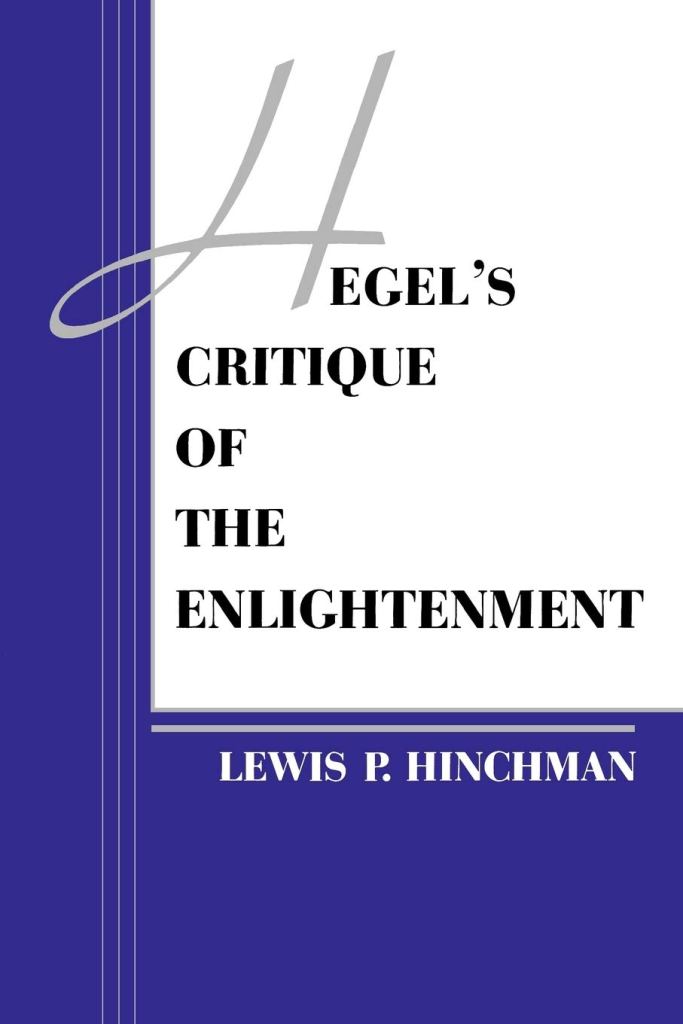
Hegel’s Critique of the Enlightenment by Lewis P. Hinchman offers an examination of the complex interplay between Hegelian philosophy and Enlightenment thought. The Enlightenment, a period celebrated for fostering human rights, toleration, popular sovereignty, and progress, also carries a contentious legacy marked by instrumental reason, mechanistic determinism, hostility to religion, and political atomism. Hinchman delves into how Hegel, as one of the first major philosophers to recognize this ambivalence, undertakes a systematic critique of the Enlightenment’s epistemological and sociopolitical foundations.
Hinchman presents Hegel as a critical yet sympathetic interlocutor of the Enlightenment. He argues that Hegel’s nuanced engagement with Enlightenment ideas anticipates and, in some respects, surpasses the critiques offered by influential nineteenth- and twentieth-century philosophers. Hegel’s exploration of the self, which Hinchman identifies as the core of his critique, stands in stark contrast to the substantialist notions prevalent among Enlightenment thinkers like Descartes, Kant, and Fichte. Hegel’s non-substantialist conception of the self eschews reification, presenting a dynamic, evolving understanding of human identity that addresses the limitations of his predecessors’ theories.
Hinchman’s work appeals to a diverse audience, including political scientists, intellectual historians, philosophers, and students of comparative and nineteenth-century German literature. His comparative methodology brings together texts and passages often studied in isolation, offering a cohesive analysis that spans multiple disciplines. This approach not only illuminates Hegel’s philosophical project but also underscores its relevance to contemporary political and philosophical discourses.
Hinchman contextualizes his study within the political and intellectual upheavals of the 1960s, drawing parallels to Hegel’s own time. He reflects on his initial encounter with Hegel during his studies in Germany, a period marked by intense political crisis and disillusionment. Hinchman finds in Hegel’s skepticism towards simplistic identifications and his advocacy for philosophical humility and self-criticism a valuable framework for understanding the contemporary condition.
Hinchman’s reconstruction of Hegel’s concept of the self reveals how Hegel partly adopts and significantly transforms Enlightenment ideas. By rejecting the substantialist view, Hegel develops a conception of the self that is not a static entity but a process of self-realization within a historical and social context. This dynamic view allows Hegel to critique the Enlightenment’s epistemology and socio-political practices, highlighting their one-sidedness and potential for ideological blindness.
Hinchman argues that Hegel’s critique extends beyond mere negation to offer constructive insights into modernity. Hegel’s analysis of the “fragmented egos” and “beautiful souls” of his age provides implicit criticisms of contemporary ideologies, revealing their flawed understanding of human nature and social reality. Hegel’s critique of the Enlightenment thus becomes a call for deeper philosophical engagement, urging modern thinkers to confront the complexities and contradictions of their time.
The book is also a critical examination of Hegel’s philosophy of right, where Hinchman identifies a significant inconsistency in Hegel’s political thought. Despite his overall sympathetic approach, Hinchman does not shy away from challenging Hegel where he deviates from his own principles, particularly in his treatment of political authority and individual freedom.
Hegel’s Critique of the Enlightenment is a great analysis of how Hegel navigates the promises and pitfalls of Enlightenment thought. Hinchman’s nuanced interpretation clarifies Hegel’s complex relationship with Enlightenment ideals, offering a robust framework for understanding the evolution of self-consciousness, freedom, and ethical life. By situating Hegel’s critique within both historical and contemporary contexts, Hinchman underscores the enduring relevance of Hegel’s philosophy in grappling with the challenges of modernity.
Hinchman’s work not only enriches our understanding of Hegel but also provides valuable insights into the broader philosophical and political implications of the Enlightenment. By engaging deeply with Hegel’s thought, Hinchman invites readers to reconsider the foundations of modern Western civilization and the philosophical underpinnings of contemporary political and social structures.
 Simon Gros
Leave a comment