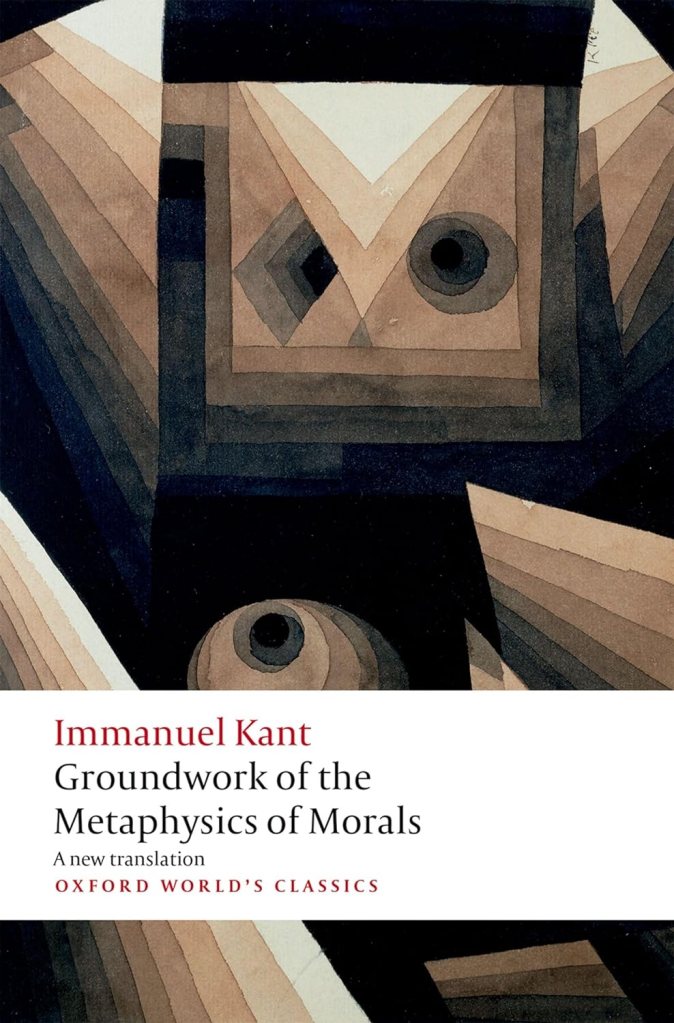
Immanuel Kant’s Groundwork of the Metaphysics of Morals, published in 1785, stands as a cornerstone of moral philosophy, earning its place alongside Plato’s Republic and Aristotle’s Nicomachean Ethics. In this seminal work, Kant embarks on a journey to uncover and validate the supreme principle of morality: the categorical imperative. His argument is rooted in the intrinsic value of human beings as ends in themselves, never to be exploited merely as means, and the recognition of universal, unconditional obligations as manifestations of human autonomy and self-governance.
The Groundwork is fundamentally an exploration and defence of moral self-governance based on pure reason. Kant dissects the nature of moral law, advocating that our actions must be governed by maxims that could be universally applicable, thus respecting the rational agency of all individuals. This work underscores the notion that moral actions are not driven by self-interest or external influences but by an inherent motivation to adhere to the moral law, which he argues is an expression of our freedom as rational agents.
Kant’s treatise is a response to the challenges posed by scientific determinism and ethical subjectivism, reaffirming the possibility of free will and moral responsibility. By establishing the categorical imperative as a universal principle, he redefines the ethical landscape, distinguishing it from the simplistic reciprocity of the Golden Rule. The categorical imperative demands a more rigorous adherence to rational principles, beyond personal inclinations or societal norms.
Central to the Groundwork is Kant’s delineation of the will, duty, and the good will, alongside his insistence on objective principles to guide moral action. He categorizes these principles into hypothetical and categorical imperatives, emphasizing the necessity of the latter for true moral conduct. Kant’s rigorous analysis extends to the formulation of universal law, advocating for the creation of moral laws that withstand the scrutiny of rational agents universally.
This work, with its enduring impact and contentious interpretations, continues to be a pivotal reference in ethical theory. Kant’s articulation of moral philosophy, grounded in autonomy and rationality, challenges us to conceive of a moral universe governed by objective, universal principles, and to act in accordance with the moral law that defines our freedom and rational agency.
 Simon Gros
Leave a comment