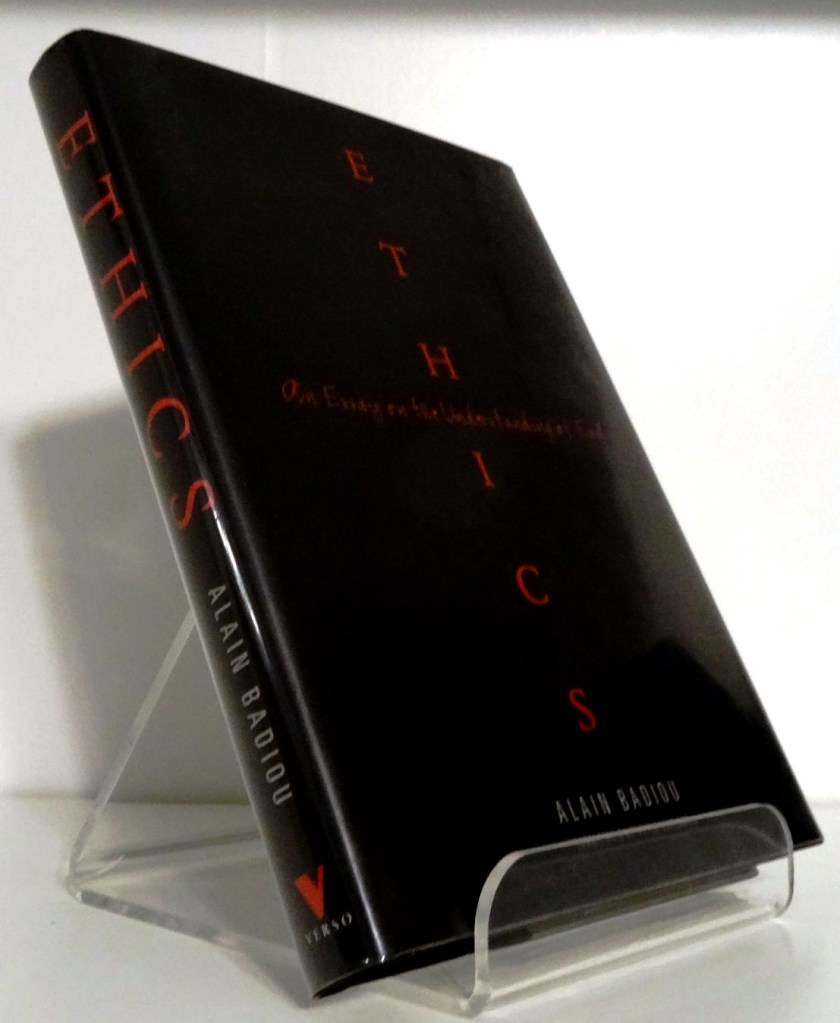
Ethics: An Essay on the Understanding of Evil by Alain Badiou challenges the prevailing ethical consensus of our time with a potent philosophical critique. In an era where ethical discourse has become synonymous with safeguarding human rights and promoting respect for the Other, Badiou boldly interrogates these principles as merely reinforcing the status quo.
At the heart of Badiou’s argument lies a profound skepticism towards what he terms the “ethical turn” of contemporary thought. He contends that the ethical frameworks in vogue today, often rooted in a liberal humanist tradition, ultimately serve to maintain a complacent ideological hegemony. These frameworks, Badiou argues, fail to provide a robust understanding of the concept of evil and its implications.
Rather than acquiesce to a superficial consensus on ethics, Badiou advocates for an “ethic of truths.” This alternative ethical paradigm champions a disciplined adherence to truths that transcend mere human rights and cultural relativism. It calls for a militant commitment to causes—be they political, scientific, artistic, or romantic—that defy the inertial pull of the status quo. Badiou posits that genuine ethical engagement necessitates a departure from the comfort of universal human rights towards a more rigorous, partisan universality that challenges established norms and interests.
Central to Badiou’s critique is the notion that the prevalent ethical discourse of today is inherently conservative. It rests on two philosophical poles—a universalizing impulse that flattens the richness of particular contexts into abstract principles, and a differential approach that fixates on cultural differences without addressing deeper structural inequalities. Badiou argues that both poles ultimately serve to legitimize existing power dynamics and stifle radical change.
Drawing from his extensive philosophical framework—which includes influences from mathematics, psychoanalysis, and Marxism—Badiou constructs a provocative thesis on ethics. His exploration delves into the complexities of betrayal, delusion, and terror as perversions of truth, which he identifies as manifestations of evil. He challenges readers to rethink conventional moral vocabularies that often obscure deeper ethical dilemmas and to embrace a more nuanced understanding of ethical responsibility.
Ethics emerges as a rigorous manifesto against the prevailing ethical consensus. It is not merely a critique but a call to intellectual arms, inviting readers to reconsider the foundations of contemporary ethical thought and to engage with ethics in a way that transcends the limits of consensus-driven complacency. Badiou’s work resonates as a formidable intervention in philosophical discourse, challenging readers to confront the uncomfortable truths obscured by prevailing ethical paradigms and to reevaluate their ethical commitments in light of a more rigorous and uncompromising ethical framework.
 Simon Gros
Leave a comment