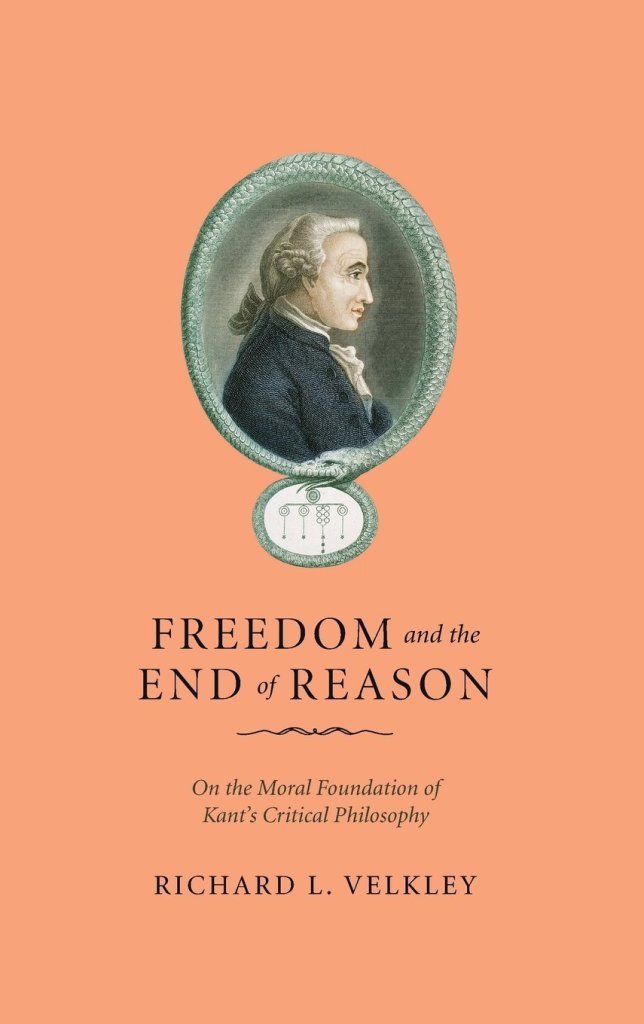
Freedom and the End of Reason by Richard L. Velkley is an influential and meticulously argued interpretation of the central issues in Kant’s philosophy, evaluating its pivotal position within the larger historical context of modern philosophy. Velkley posits that the entirety of Kantian philosophy, beyond merely the Second Critique, revolves around a “critique of practical reason.” He contends that Kant’s philosophical project addresses an inherent problem within reason itself: the teleological problem of its intrinsic goodness.
Velkley reconstructs the profound impact of Rousseau on Kant, revealing a deeper, more intricate relationship between speculative and practical philosophy in Kant’s work than traditionally recognized. By emphasizing a Rousseau-inspired concept of reason as inherently aimed at providing practical ends, Velkley offers a comprehensive account of Kant’s idea of moral culture. This innovative perspective not only redefines the scope and significance of Kant’s critique but also situates it within the broader philosophical discourse.
Through a detailed examination of Kant’s precritical writings and their ethical reflections from the 1760s, Velkley underscores the importance of understanding the moral and practical end of reason as the foundation of Kant’s critical philosophy. This approach illuminates the underlying unity of Kant’s theoretical and practical endeavors, portraying his entire philosophical enterprise as a coherent response to the Enlightenment’s crisis regarding the purpose and status of reason. Velkley demonstrates that Kant’s engagement with Rousseau prompted a transformative “Rousseauian turn” in his thought, preceding and conditioning his later “transcendental turn.”
Velkley’s work is lauded for its depth and scholarship, skillfully navigating the complex interplay between Kant and Rousseau to provide fresh insights into Kant’s philosophical development. By moving beyond traditional debates about influence, Velkley highlights how Kant’s response to Rousseau’s challenges shaped his critical philosophy, proposing a new justification for reason that reconciles theoretical and moral pursuits within an overarching moral framework.
This scholarly work delves into the teleological aspects of reason, exploring how Kant sought to reform metaphysical determinations of reason to address the moral imperatives and practical applications central to human dignity and freedom. Velkley’s analysis reveals the integral role of the “primacy of the practical” in Kant’s thought, suggesting that the moral foundation of Kant’s philosophy is essential for comprehending its full scope and significance.
Freedom and the End of Reason is an essential text for scholars of Kant, Rousseau, and Enlightenment philosophy, offering a profound re-evaluation of the moral dimensions underpinning Kant’s critical philosophy. Velkley’s interpretation challenges readers to reconsider the philosophical landscape of modernity, providing a nuanced understanding of the enduring dialogue between reason, morality, and freedom that continues to shape contemporary thought.
 Simon Gros
Leave a comment