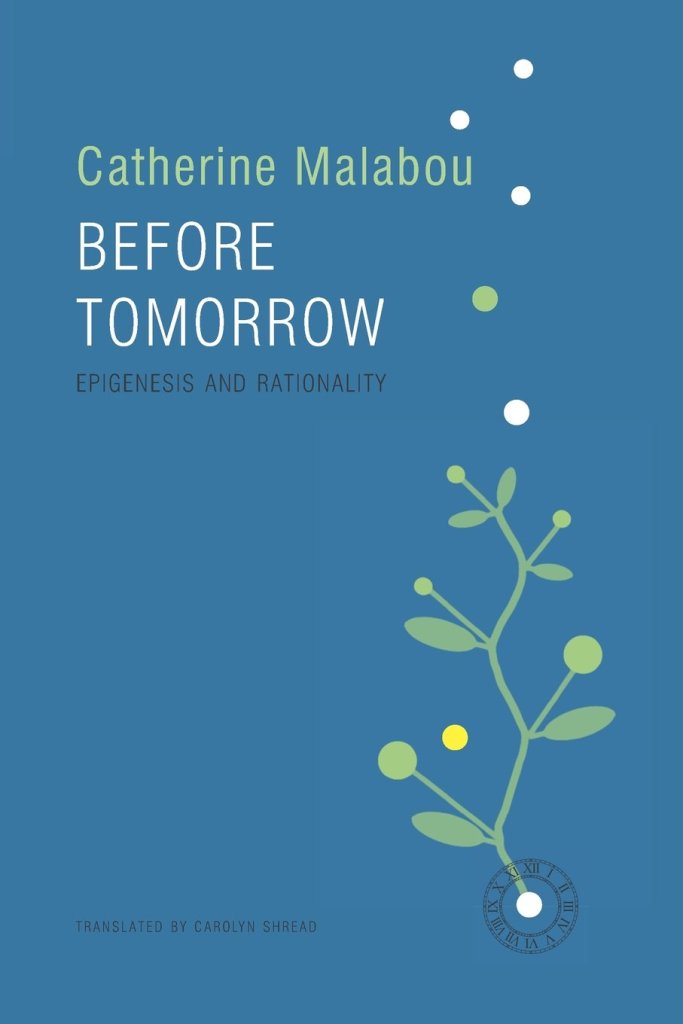
In Before Tomorrow, Catherine Malabou embarks on a profound exploration of contemporary continental philosophy’s pivotal shift from Kantian epistemology. Malabou challenges the long-held Kantian structures of knowledge by interrogating the finitude of the subject, the phenomenal given, and the a priori synthesis. Her work addresses the burgeoning imperative to relinquish the transcendental, a cornerstone of postcritical thinking in the 21st century.
Malabou raises fundamental questions: Can Kant maintain a clear distinction between the a priori and the innate? Can he legitimately deduce the categories or justify the necessity of nature? The confluence of recent neurobiological insights with these philosophical inquiries casts doubt on the transcendental idealism that Kant espoused. Malabou suggests that cognitive processes may indeed have a biological origin, challenging the Kantian separation of logical and biological realms.
Before Tomorrow evolves as an epigenesis, mirroring the differentiated growth of an embryo, to reflect the dynamic nature of the transcendental itself. Malabou’s epigenetic model of the transcendental proposes an auto-transforming, self-differential process that finds its roots in Kantian thought but extends beyond Heideggerian temporalization and Meillassoux’s critique of contingency.
Malabou’s inquiry is anchored in three pivotal questions that unveil the silent paradoxes within contemporary continental philosophy: the obsolescence of the question of time post-Heidegger, the disconnect between reason and recent neurobiological discoveries, and the current status of Kantian authority. She examines the instability of the transcendental, not to dismiss it but to transform it by incorporating speculative thinking into biological discourse.
Esteemed scholars praise Malabou’s work for its clarity, originality, and philosophical depth. John D. Caputo highlights the book as a milestone in the philosophy of transformability and plasticity, while Ian James commends Malabou’s integration of the transcendental and biological into a new epigenetic paradigm. Joan Copjec lauds Malabou’s defense of the transcendental by advocating for a speculative biology that embraces philosophical inquiry.
In her incisive introduction, Malabou identifies the three questions that drive her analysis: the philosophical neglect of time, the resistance to integrating neurobiological insights into philosophical discourse, and the challenge to Kant’s foundational authority. She delves into Meillassoux’s notion of correlationism and the call to relinquish the transcendental, emphasizing the necessity of thinking antecedence beyond the a priori.
Malabou critically assesses the traditional readings of Kant, revealing the inherent instability in the transcendental deduction. She addresses the paradox of original acquisition, where the a priori is neither innate nor derived from experience but originates through a process that Kant describes as neither fully explained nor self-evident.
Before Tomorrow is a transformative work that confronts the foundational issues in Kantian philosophy and proposes a new model of the transcendental, one that acknowledges its biological and epigenetic dimensions. Malabou’s book is a significant contribution to contemporary philosophical discourse, offering a compelling vision of the future of transcendental thought.
 Simon Gros
Leave a comment