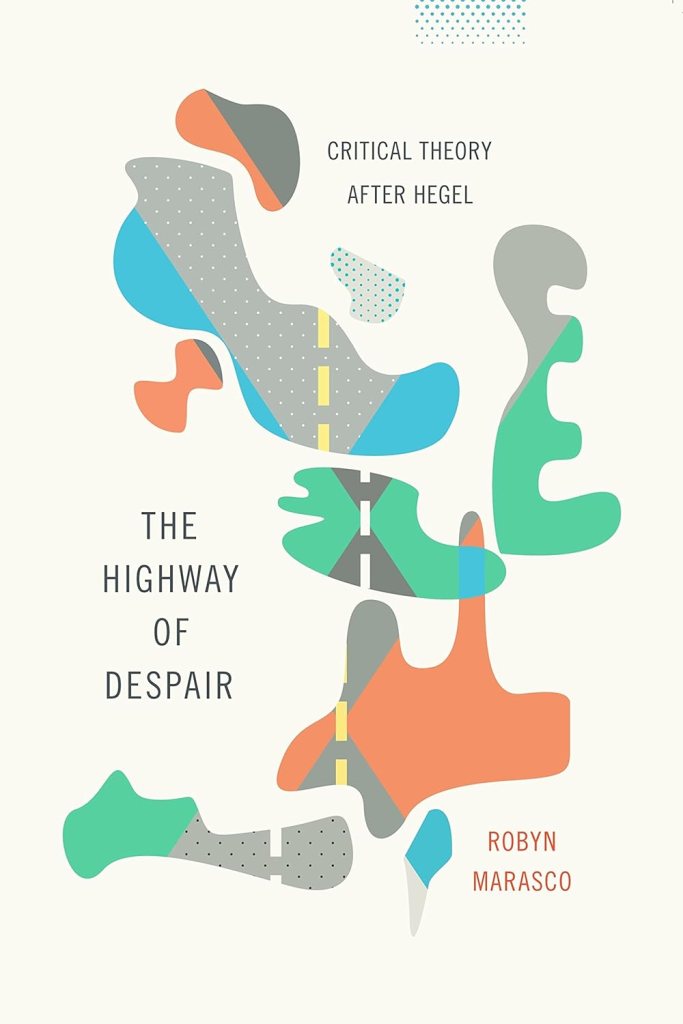
The Highway of Despair by Robyn Marasco is an intricate and profound exploration of the dynamic interplay between despair and critical theory, tracing a lineage that begins with Hegel’s “highway of despair” in his Phenomenology of Spirit. Hegel’s notion captures the arduous journey of “natural consciousness” towards freedom, underscored by despair as both a harbinger of freedom and a reservoir of hope. Marasco delves into this paradoxical sentiment, uncovering how despair, while seemingly debilitating, can ignite radical critique and sustain political praxis.
Marasco’s work critically engages with Theodor Adorno, Georges Bataille, and Frantz Fanon, examining how each thinker interacts with Hegelian thought. These figures grapple with the erosion of revolutionary dialectics in the face of genocidal racism, global conflict, and colonial subjugation, thereby redefining Left Hegelianism. Each of these theorists centralizes the role of passion in critique, challenging the recent trends in critical theory that seek to evade despair. Marasco posits that embracing the extremism of Marx’s “ruthless critique of everything existing,” and the passions therein, breathes new life into critical theory.
Through meticulous analysis, Marasco shows that despair, far from being a dead end, acts as a potent force in challenging control, authority, and domination. This “negative passion” fosters political imagination and invigorates critical thought, offering a radical revaluation of critical theory. Her work emphasizes the necessity of engaging with the world’s injustices and irrationalities, using the passion of despair to fuel transformative critique.
Marasco’s The Highway of Despair re-centers the Frankfurt School’s critical theory tradition by spotlighting its passionate undercurrents. She counters Habermas’s systematic rationalism with a rich variety of negative dialectics, revealing a counter-tradition within Left Hegelianism that acknowledges and harnesses the persistent violence and irrationality of the world. Her argument is not merely theoretical but deeply practical, offering a militant and passionate approach to political thought.
This book has garnered acclaim for its profound insights and innovative interpretations. Scholars have praised its capacity to reinvigorate the dialectical imagination and reshape the landscape of critical theory. Marasco’s focus on negative passions as sources of critique and political engagement marks a significant departure from more conventional approaches, positioning despair as a fertile ground for radical thought and action.
 Simon Gros
Leave a comment