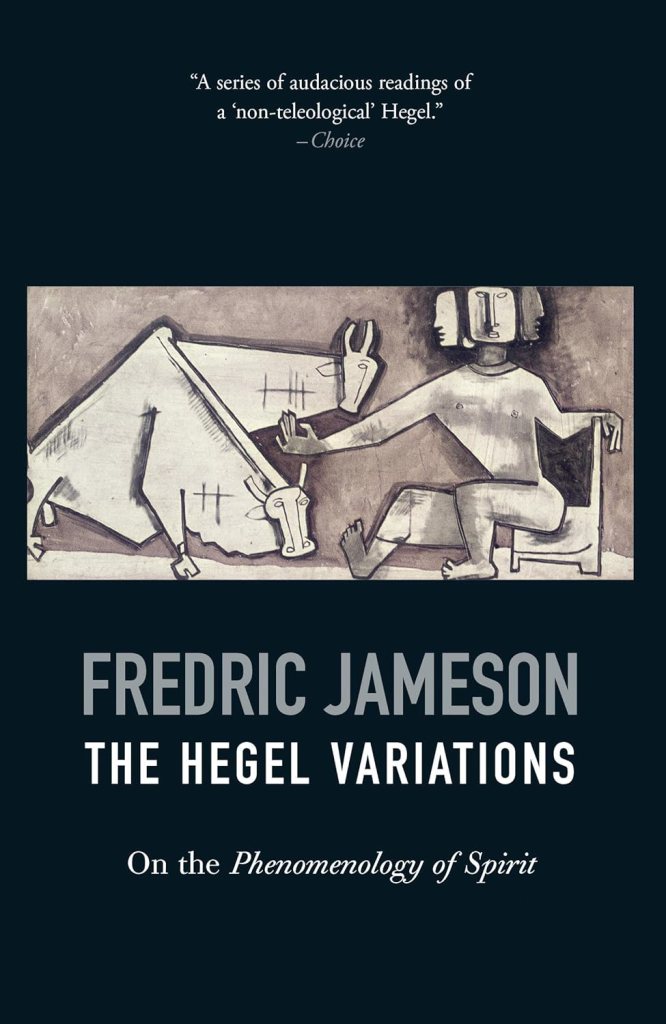
Master philosopher and cultural theorist Fredric Jameson offers an audacious new reading of Hegel’s foundational text, Phenomenology of Spirit, in this major study. Unlike interpretations that perceive the Phenomenology as a closed system culminating in Absolute Spirit, Jameson presents it as an open, dynamic work where Hegel had yet to fully systematize his philosophy. Here, the moments of the dialectic remain fluid, resisting reification into fixed philosophical concepts.
Jameson’s reading diverges sharply from Francis Fukuyama’s “end of history” thesis, suggesting instead that the Phenomenology concludes with a provisional stalemate between the political and the social—an interpretation with significant implications for understanding our contemporary world. The book traverses key themes of Hegel’s work, including the master-slave dialectic, linguistic subjectivity, expressive production, normative divisions in Antigone, and the reverberations of the French Revolution.
In a series of meticulously crafted arguments, Jameson illustrates how Hegel’s text operates through a dazzling variety of conceptual shifts, which never congeal into stable, named philosophical entities. This non-teleological reading reveals a Hegel who is not the complacent system builder of traditional interpretations but a thinker whose work remains ever restless and open-ended.
Jameson challenges the conventional image of Hegel as a proponent of a developmental narrative culminating in Absolute Spirit. Instead, he portrays Hegel’s work as anomalous and untimely, a critique of the very historicity often attributed to it. The Phenomenology’s final chapters on religion and absolute knowing are seen as outliers, uncharacteristically perfunctory, and misaligned with the rest of the text.
By emphasizing the tension and contradiction inherent in Hegel’s dialectic, Jameson’s reading underscores the productivity of these elements, positioning the Phenomenology as a text that remains profoundly relevant. The conflict between individual consciousness and collective existence, as well as the dialectic between self and other, is explored with fresh insights, particularly through the re-examination of the master-slave dialectic and the social dynamics in Hegel’s treatment of Antigone.
Jameson’s study culminates in a compelling discussion on the implications of Hegelian thought for understanding globalization. He suggests that while the traditional bases of privilege are dissolving, a new conceptual framework is required to grasp the humanized yet not fully subjectivized global reality. This reading aligns the Hegelian dialectic with contemporary socio-economic conditions, framing it as a tool for navigating the complexities of modernity.
The Hegel Variations is not merely an exegesis of Hegel’s Phenomenology but a performance of the dialectic itself. Through his incisive and often polemical analysis, Jameson not only reinterprets Hegel but also invites readers to engage with the present moment of global transformation. This dense, elegant study is a crucial text for anyone seeking to understand the ongoing relevance of Hegelian thought in the face of modern challenges.
 Simon Gros
Leave a comment