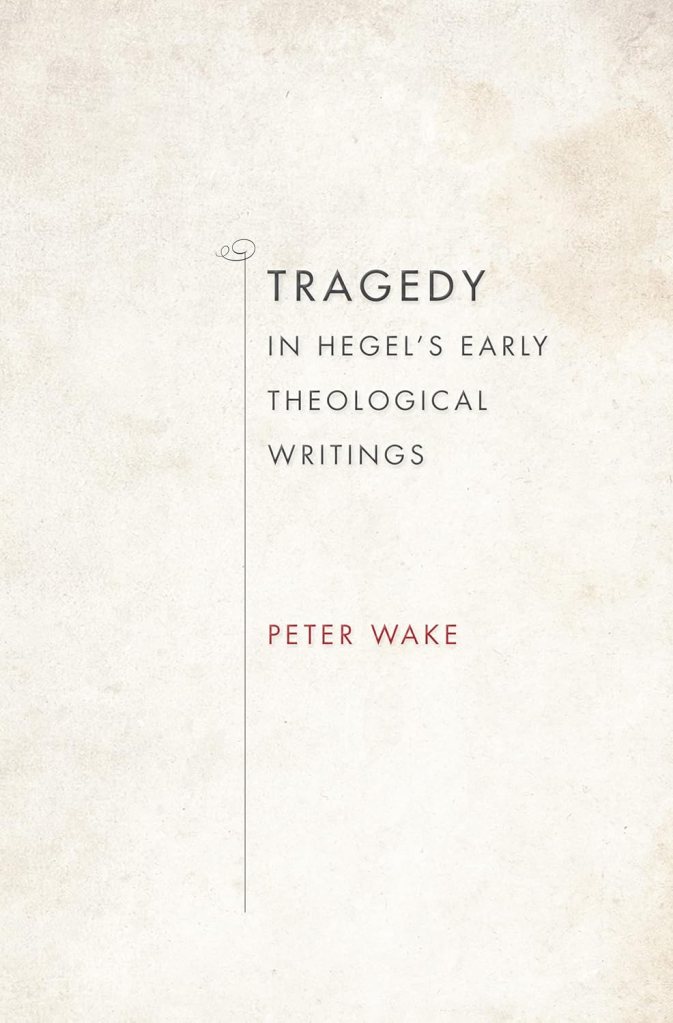
In Tragedy in Hegel’s Early Theological Writings, Peter Wake undertakes a profound exploration of Hegel’s early philosophical and theological works, illuminating a transformative period in Hegel’s intellectual development. Wake posits that Hegel, in his formative years, ingeniously utilized tragedy as a diagnostic lens. Through this tragic framework, Hegel sought to elucidate the unfolding dynamics of religions and the undulating currents of history itself.
Central to Wake’s thesis is Hegel’s innovative approach to mythology. In these early writings, Hegel endeavors to discern a mythological framework that could harmonize with the burgeoning ideals of religious and political freedom in the modern era. Wake contends that Hegel found inspiration in ancient Greek tragedy, viewing it as a paradigmatic model. This perspective not only aimed to critique the entrenched hierarchies and authoritarianism prevalent in Hegel’s contemporary Europe but also proposed an alternative path forward rooted in the tragic ethos.
Critically acclaimed for its scholarly depth, Wake’s work resonates across Hegelian studies. Cyril J. O’Regan of the University of Notre Dame lauds Wake’s book as a tour de force, combining meticulous textual analysis with a panoramic view that extends beyond Hegel’s early writings to underscore their enduring relevance. Wake’s examination teases out subtleties and contradictions within Hegel’s texts, enriching our understanding of their complexity and timeless significance.
Moreover, Wake’s study confronts Hegel’s transition in thought, particularly in his assessment of Christianity. Initially critiquing institutional religion as stagnant and authoritarian, Hegel later re-evaluates Christianity, recognizing its potential as a vehicle for love, freedom, and reconciliation—a viewpoint Wake carefully analyses.
However, Wake’s conclusions are not merely celebratory; they provoke critical engagement. His assertion that Hegel ultimately rejects ancient Greek tragedy as a viable model for modern religio-cultural renewal challenges conventional interpretations. Wake argues that modernity’s profound alienation and fragmentation exceed the scope of tragic resolution, suggesting a deeper existential crisis encapsulated by Hegel’s concept of the “unhappy consciousness.”
Tragedy in Hegel’s Early Theological Writings is not just a scholarly inquiry but a philosophical journey. It invites readers to delve into Hegel’s evolving thought during a pivotal phase, offering insights into how tragedy served as both a diagnostic tool and a philosophical crucible for Hegel’s nascent ideas on myth, religion, and the evolving contours of human freedom.
 Simon Gros
Leave a comment