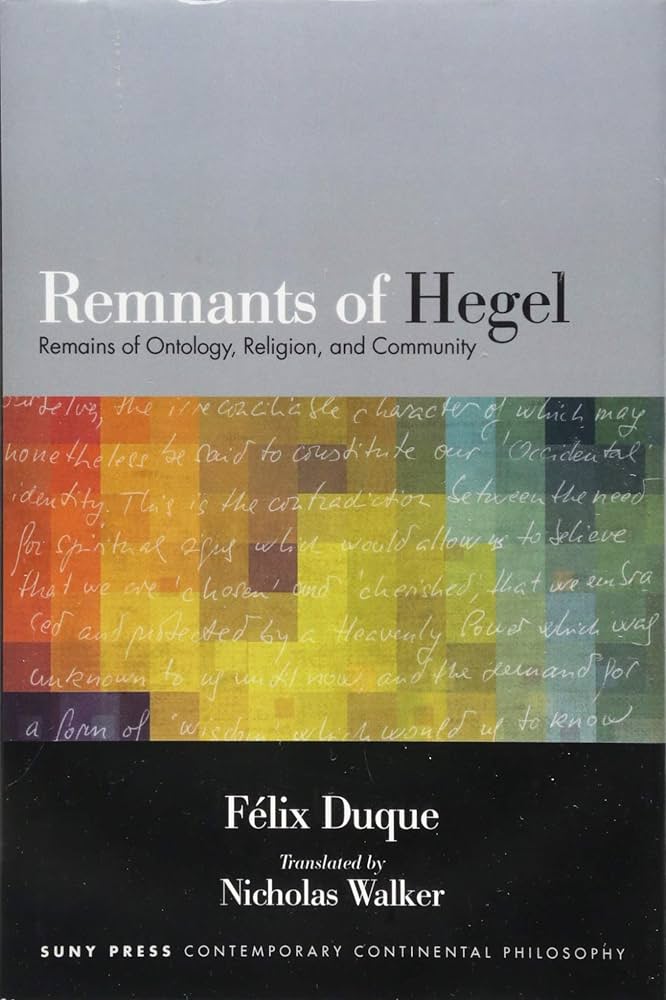
Remnants of Hegel by Félix Duque delves deep into the lingering echoes of Hegelian thought, challenging conventional interpretations to unearth profound insights into the enduring relevance of Hegel’s philosophy. Positioned as a critical response rather than a mere exposition, Duque’s work scrutinizes Hegel’s quest to construct a comprehensive philosophical system that transcends the complexities of human existence.
At the heart of Duque’s inquiry lies the tension between universality and singularity, a theme explored through both metaphysical and theological lenses. Drawing from Hegel’s intricate theories, Duque navigates pivotal concepts such as substance, subjectivity, and the interplay between human and divine attributes in figures like Jesus. These explorations compel a search for foundational authority, a quest rooted in Hegel’s theory of “second nature” and its implications for societal frameworks like the nation-state.
Duque’s critique extends to Hegel’s evaluations of historical events such as the French Revolution, dissecting their impact on political structures and civil life. Additionally, he delves into Hegel’s theological reflections, particularly examining notions of authority and guilt as they evolve through Christian doctrine.
Through rigorous scholarship and a sharp philosophical lens, Duque challenges prevailing interpretations, offering a nuanced perspective that enriches our understanding of Hegel’s legacy. This book stands not only as a profound analysis of Hegelian thought but also as a testament to Duque’s stature as a leading philosopher in the Spanish-speaking world. His insights, deftly translated by Nicholas Walker, invite readers into a profound dialogue on ontology, religion, and community, resonating with both scholars and enthusiasts of philosophy alike.
Remnants of Hegel emerges as a pivotal contribution, inviting readers to reconsider Hegel’s enduring relevance and the complex interplay between philosophy, theology, and the evolving fabric of human society. Félix Duque’s scholarship exemplifies a lifelong dedication to probing the boundaries of philosophical inquiry, making this book essential reading for anyone grappling with the intersection of theory and practice in contemporary thought.
 Simon Gros
Leave a comment