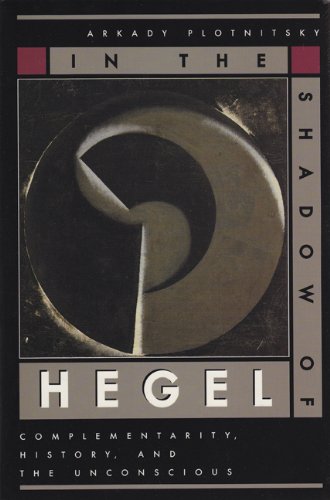
In the Shadow of Hegel by Arkady Plotnitsky ventures into the profound recesses of historical and philosophical inquiry, crafting a narrative that operates within the ambit of Hegelian thought while simultaneously contesting its principles. Plotnitsky scrutinizes the pervasive influence of Hegel’s conception of history as the manifestation of the Absolutely Self-Conscious Spirit—Geist—through the perspectives of key intellectual figures such as Marx, Nietzsche, Freud, Bataille, and Derrida. This examination reveals both the convergences and divergences between Hegelian and poststructuralist understandings of history.
Plotnitsky’s work introduces a theoretical framework rooted in the poststructuralist tradition, particularly through the concept of complementarity derived from Niels Bohr’s interpretation of quantum mechanics. This framework is intertwined with the notion of general economy, as developed by Bataille and Derrida via Marx, Nietzsche, and Freud. Within this matrix, Plotnitsky explores the interplay between history and the unconscious, transforming these concepts through their mutual interaction under the rubric of general economy and complementarity.
The book delves into the implications of quantum mechanics and advancements in modern mathematics and science, especially along the axis of general economy. Plotnitsky elucidates the reciprocal influences and interpenetrations between scientific developments—from Newton to Einstein and Bohr—and intellectual trajectories from Hegel to Nietzsche to Derrida. This synthesis unveils new possibilities for metaphorical and conceptual exchanges across various fields of inquiry.
With an academic background in mathematics and comparative literature, Plotnitsky’s interdisciplinary approach is evident in his meticulous analysis. He navigates the complex relationships between history, consciousness, and the unconscious, proposing that a true departure from Hegelian thought necessitates a radical reconfiguration rather than outright rejection. This comprehensive historico-theoretical framework aligns with the multifaceted nature of complementarity, embracing the necessity of parallel processing in theoretical and historical analysis.
Through rigorous examination, Plotnitsky demonstrates how general economy challenges classical theories by revealing the inevitable excess and loss of meaning within any system, positioning this critique against Hegel’s philosophy. The book’s structure, embodying the principles of complementarity, offers overlapping and interpenetrating areas of focus that continuously engage with Hegel’s shadow.
Ultimately, In the Shadow of Hegel posits that understanding history requires a simultaneous engagement with Hegelian and post-Hegelian thought, fostering a dialogue that transcends linear analysis. By navigating the tensions and affinities between these intellectual currents, Plotnitsky illuminates the intricate dance between history and the unconscious, inviting readers to reconsider the foundations of historical and philosophical inquiry.
 Simon Gros
Leave a comment