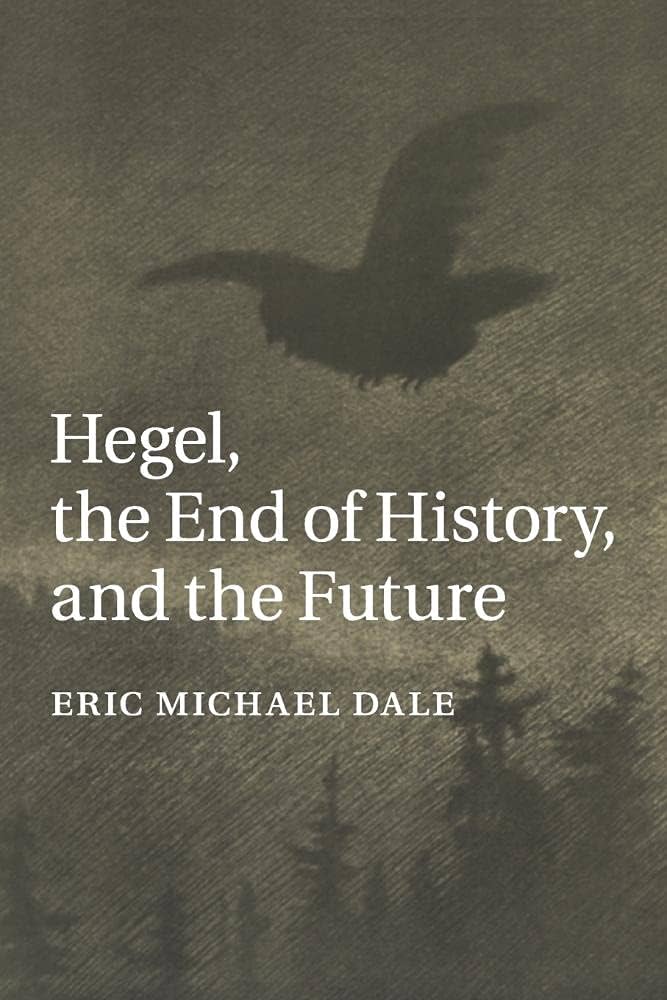
In Hegel, the End of History, and the Future, Eric Michael Dale embarks on a critical re-examination of the widely-held interpretation of Hegel’s Phenomenology of Spirit (1806) as the proclamation of the ‘end of history.’ This groundbreaking work, the first in English to thoroughly challenge this entrenched view, contends that such an interpretation fundamentally misrepresents Hegel’s philosophical intentions. Dale offers a meticulously argued alternative reading that situates Hegel’s concept of the ‘end of history’ within the broader context of his philosophy, revealing a nuanced understanding that has been obscured by reductive interpretations.
Through an elegant and detailed analysis, Dale guides readers away from the oversimplified notion of a definitive end point in historical development towards a more sophisticated appreciation of Hegel’s vision. He illuminates how Hegel’s philosophy of history is deeply interconnected with his larger metaphysical and epistemological frameworks, emphasizing the perpetual progress of spirit rather than a terminal point of historical culmination. This interpretation opens up new avenues for engaging with Hegel’s thought, showing how it accommodates ongoing historical development and the continual unfolding of human freedom.
Dale’s critique is not only a significant contribution to Hegelian scholarship but also a valuable resource for advanced students and scholars of the philosophy of history and political thought. By disentangling Hegel’s complex ideas from the misconceptions that have long surrounded them, Dale reinvigorates the study of Hegel, demonstrating its relevance and potential for contemporary philosophical inquiry.
Eric Michael Dale, PhD, is an Affiliated Faculty Professor at Emerson College and Senior Adjunct Professor of Philosophy at Fisher College, Boston. Specializing in German continental philosophy of the 18th-20th centuries and an expert on religious philosophy across multiple cultures, Dr. Dale brings a profound and diverse expertise to his analysis of Hegel. His scholarly work is informed by his experiences as a former visiting fellow at the Institut für die Wissenschaften vom Menschen in Vienna, Austria.
 Simon Gros
Leave a comment