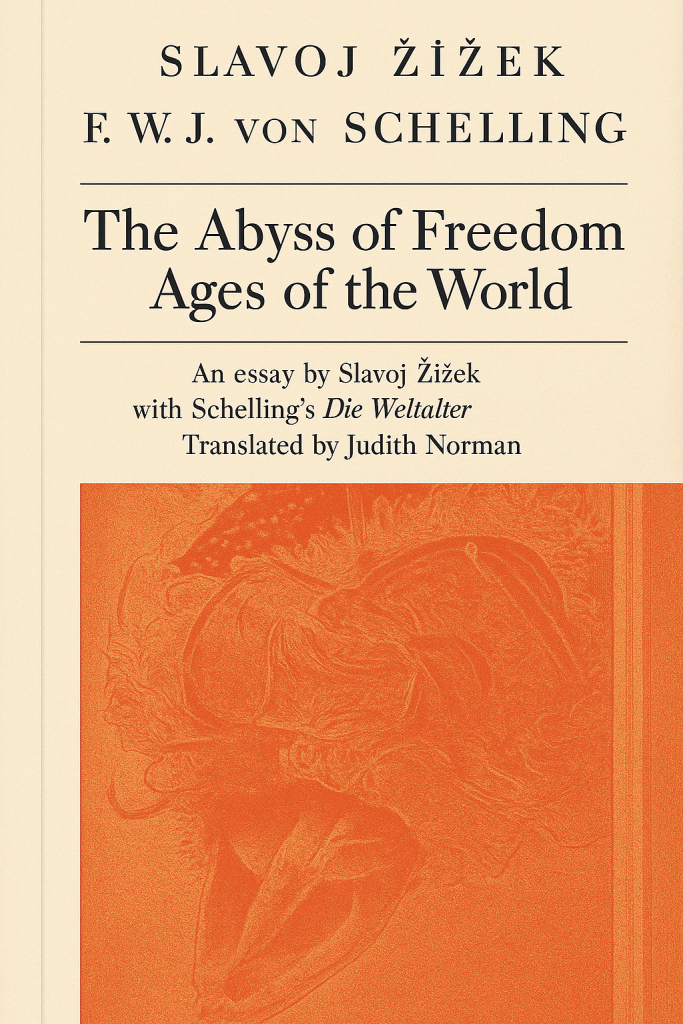
The volume brings together a philosophically exacting, mutually intensifying pairing: Slavoj Žižek’s The Abyss of Freedom and F. W. J. von Schelling’s second draft (1813) of The Ages of the World in Judith Norman’s translation. Its distinctive contribution is in the way it treats Schelling’s speculative cosmology and theology as the most rigorous site for thinking freedom under the sign of an originary fracture, and then tests that site against a psychoanalytic account of subject formation. The book’s main thesis is precise: it develops a concept of freedom whose ground is an abyssal preontological willing, articulates time as the result of a decisive act that represses a prior rotary motion of drives, and clarifies how the rational world (logos) depends upon what in God is not yet God. Žižek’s framing essay thereby provides a methodological relay for reading Schelling with Lacan without subduing Schelling’s own architectonics; the translation of the 1813 draft then displaces and deepens this relay by exposing the textual pressures that make the system break where it must, at the attempted passage from eternity to time and from impersonal freedom to a free subject.
The volume is externally framed and internally divided in a way that instructs its philosophical use. The book comprises, first, Žižek’s essay and, second, Norman’s English translation of Schelling’s Die Weltalter (second draft, 1813), with bibliographic apparatus and the imprinting context of the Michigan series The Body, in Theory; the publisher identifies the contents succinctly as “an essay by Slavoj Žižek with the text of Schelling’s Die Weltalter (second draft, 1813) in English translation by Judith Norman.” The formal partition is signaled in the internal table that places Žižek’s The Abyss of Freedom up to the folio that precedes Ages of the World beginning on p. 105, thus establishing the essay as a conceptual prolegomenon and the translation as the site of textual adjudication.
Žižek’s opening thesis is disciplined: the classical enigma is reversed. The question is less how freedom enters a world otherwise governed by reasons, than how the world ever became captive to reasons at all. Schelling names the problem exactly: the world is thoroughly ensnared in reason, and yet the philosophical task is to explain how it fell into this net in the first place. Žižek situates this reversal where Schelling’s thought labors at its most intense—across the three fragments of Weltalter (1811–1815)—and he stresses why the 1813 version is selected: the second draft is the most stringent presentation of the problem of the Word’s emergence from a pre-symbolic rotary motion of drives and the most explicit theatre of failure at the very hinge where Past must be differentiated from Present. The text breaks at the point where it must not break, which in Žižek’s estimation is the acme of German Idealism precisely because it forces into view a post-Idealist domain otherwise occluded by later “settlements.”
The analytic center is Schelling’s division between Existence and its Ground (Grund), and the attendant insistence that evil becomes thinkable only if the Absolute itself is internally split. The Ground is neither a second, co-equal principle nor a positive base that props Reason; it has a pre-ontological status—it is less than existence while corroding existence from within. The Absolute that exists is illuminated by the Word, while the Absolute as obscure longing (Sehnsucht) strives without determinate object and thus withholds full identity from God; there is something in God that is not God. This internal alterity Schelling calls Selbstheit (self-sameness, a contractive selfhood), designating a force that is necessary for the expansion of the Word and yet actively resists it. Žižek clarifies the paradox: the Perfect requires the Imperfect to assert itself; completeness consists in the unity of Perfect and Imperfect, which is why the “intersection” of the Perfect with the Imperfect can appear more perfect than the Perfect taken alone.
The conceptual leverage of this distinction is considerable. First, it undermines dualisms of cosmic principles and refuses the retrojection of a metaphysical Masculine/Feminine schema into the Absolute, even as Schelling employs sexualized language for the relation of Ground and Existence. The Ground is portrayed as the “feminine” impenetrable base and the Word as “masculine” articulation; if this base usurps primacy, the nourishing background becomes destructive fury. Žižek extracts the methodological point from the rhetoric: the Ground’s negativity, as contractive opposition to logos, is the very kernel of subjectivity—subject as gap, as distance-from-itself, as a power that withdraws from any determinate actuality and thereby permits the universe of the Word to arise.
Second, it reframes the status of “the system” under the sign of freedom. A system is not the neutral architecture in which freedom is appended as an accident; rather, a system is a totality that internalizes its own inversion. The Absolute becomes Subject only where what is subordinate can assume centrality and subordinate its presupposition—freedom therefore entails an act that risks the whole substantial content for a contingent detail (“I want this, however small, though all the world collapse”), and the “infinite right of subjectivity” is just this capacity. Freedom, system, and subject are different names for one and the same inversion, a logic that Schelling shares—while decisively reformulating—with Kant, Fichte, and Hegel.
With this architecture in place, Žižek turns to the compositional core of Weltalter: the problem of the Beginning (Anfang). The beginning of all beginnings, scripturally: In the beginning was the Word. Schelling’s constructive move is to refuse an empty eternity preceding the Word and to specify a content of eternity: a rotary motion of drives, a closed, self-consuming pulsation in which expansion and contraction contend without release. The Beginning proper is a decision—an act that differentiates past and present and thus represses the rotary motion into the eternal past. The Beginning therefore measures the passage from drive to desire, or in Lacanian terms, from the Real to the Symbolic. The technical point is decisive: the In-itself does not await our ascent; the In-itself splits from itself, acquires a distance to itself, and thus appears to itself as Word.
The stakes of this act are temporal. Time is created when the rotary motion is repressed into the past; the Word opens time as a linear progression that can host free decision. Eternity is not a modality of time; time is rather a modification of eternity, introduced to resolve an antagonism that, left unmastered, threatens a descent into madness. The temporal differentiation is qualitatively articulated: the undifferentiated pulsation is past from the start; the present is the site of division and symbolization; the future names reconciliation. This temporalization is the first deed of freedom: it suspends both the subjectless abyss of freedom and the unfree subject captured in the rotary compulsion.
But how can such a deed occur if the rotary motion of drives is ultimate? Schelling insists on a still-more-primordial Ungrund, an abyss of pure freedom that is no thing and wills nothing. From this abyss there is a contraction that “catches” Being: God contracts Being and thereby becomes a One who suffers antagonism. When contraction actualizes, the blissful peace of impersonal freedom flips into an all-consuming egotism—the divine fury of absolute contraction, intolerant of any outside. This generates anxiety: an impossibility both of full withdrawal and of full opening, a pounding impasse of repeated attempts to break out that relapse into the same closure. At this point there is a necessity for a counterstroke—expansion—and for a mediating Word that stabilizes difference. The logic is exact: only a decision that vanishes as decision can found a world that endures; the founding deed must sink back into unconsciousness so that the world does not perpetually begin again.
Žižek’s methodological wager is to pursue the implications of this construction into a theory of subjectivity and sociality without reducing Schelling to a precursor. The link to psychoanalysis is motivated by structure: the rotary motion of drives precedes symbolic difference; the Word institutes a symbolic order whose stability is perpetually threatened by what it excludes—an impenetrable remainder that cannot be fully mediated. This remainder—the kernel that in God is not yet God—appears phenomenologically as the ugly and topologically as the surplus of existence over representation; it is experienced in the too-close encounter with the Other’s jouissance. The rational order thus depends on an idealizing distance that keeps the Real from overwhelming it. When this distance collapses, the obscene underside of existence protrudes; reality shows itself as a fragile equilibrium between contractive and expansive forces, always at risk of running too fast or too slow, losing either object contour or continuity.
The reach of this alignment is thematic, not opportunistic. The same antagonistic mechanism that drives the pretemporal motion of forces also appears, in minimized form, in the social field. The symbolic order secures itself only by including its inversion—like Escher’s two hands, the Sacred that envelops the Profane is itself enveloped by the Profane as an internal excess. A liberal order that tolerates “culture” as harmless folklore displaces the problem of the Real: the Other’s jouissance returns as racial panic or ideological fixation exactly at the point where the polity claims to have neutralized the political. Žižek names this relay without diluting Schelling: the philosophical content is the same—freedom’s ground is an abyssal split, and any closure of that split functions only by hiding the remainder that sustains it.
The compositional sequence of the volume accentuates this structure through an outer and inner hinge. Outwardly, the book is a double: Žižek’s essay first, then Schelling’s text. Inwardly, Weltalter is itself a fragment; all three drafts contain only the first book, “Past,” and each breaks where the differentiation of Past and Present should be consummated in the emergence of the Word. The 1813 draft intensifies this breaking point. The editorial history is exacting in its lesson: the earlier drafts were discovered only after the war in the ruins of the Munich University library, and the 1815 text was the version known at Schelling’s death. The second draft is thus both compositionally privileged and structurally exposed; it is chosen for translation because it registers most acutely the transition it cannot complete.
Norman’s translator’s note makes the philosophical stakes of that incompletion explicit. The Ages of the World is an attempt to explain how time (especially past as grounding dimension) issued from eternity; the analysis delineates the state of things prior to creation, the forces that operate in eternity, and the free act that resolves their tension by stipulating a temporal relation. The volume preserves also a marginal self-critique in which a later continuation is crossed out with a remark that the text “falls into utter falsehoods” from a certain point onward. The note, transmitted via Schelling’s son, marks the integrity of the project: failure at this point is a principled failure, and the fragments teach by showing where reason must concede to the fact that the beginning cannot be known as beginning.
The core argumentative advance of Žižek’s essay, in its close reading of the draft, is the qualitative theory of time and the thesis that freedom becomes thinkable only by distinguishing two senses of eternity: the closed, drive-driven eternity beneath time, and the flash of eternity in time that names the free act. Eternity “begets” time to resolve the deadlock of antagonistic motion; the decisive differentiation—past repressed, present as split, future as reconciliation—inscribes freedom as the act that opens and sustains this order. The act is its own ground and can only found a world by withdrawing; otherwise the beginning would never finish beginning. In this precise sense, the Word’s institution is also a repression, the first and necessary sublimation of rotary motion into a symbolically ordered succession.
From here, problems accumulate in constructive fashion. If the Ground is less than existence and yet corrodes it, then the logic of evil cannot be an ontic deviation. The Ground belongs to the Absolute as its self-deferral. Evil is the form in which the necessity of the Imperfect within the Perfect becomes effective in a world that must achieve itself through its own contradiction. If the Absolute as Subject requires a foreign body at its heart to be itself, then the metaphysical optimism of total reconciliation is conceptually blocked: reconciliation would require the cancellation of the very negativity that grants the Absolute its actuality. Schelling’s late system continues to insist on the primordial perversion by which the lower potency usurps the higher, forming reality out of disequilibrium. This perversion is not an error recoverable by dialectical repair; it is the price of existence—as Žižek remarks, a truly materialist point that the fragments make visible in their very incompletion.
The evidentiary line remains consistently textual. The essay recurs to the 1813 draft to warrant each step: the account of Ungrund as pure willing that wills nothing, the contraction that “catches” Being, the anxious rotary persistence of a God who becomes a One without yet being Creator, the necessity of a Word that transforms pulsation into articulation. Where the text breaks, Žižek takes that break as data: the unsayability of the decisive passage is a structural sign, not an authorial lapse. He underscores that Weltalter as fragment is the charter of a post-Idealist system for which any closure of the split is either myth or repression; what remains is the rigorous description of the split, the act that opens time, and the fragile solidity of a world always at the edge of its own dissolution.
This technical rigor informs Žižek’s sparing but insistent contemporary inflections. When he adduces the phenomenon of the ugly as a surplus of existence over representation, or the experience of the Other’s jouissance as the traumatic remainder that no multicultural tolerance can domesticate, he does so by strict analogy to Schelling’s Ground vis-à-vis Existence. The point is that every legitimate universal claim in the social field presupposes a particular pathological kernel of enjoyment that binds subjects; universality is sustained by an element it cannot transparently justify. The philosophical claim is conservative of the source: the structure that permits the Word to institute time is the same structure by which a polity secures its reality. The remainder cannot be eliminated without collapsing the world into formlessness or mania.
Within this architecture, the translation of the 1813 draft does a second, displacing work. It shows how Schelling’s own prose compels the sequence from the impersonal to the personal while refusing any premature identity between freedom and a free agent. Freedom as such is the abyssal identity of an act that is its own ground; the free subject arises only where this identity contracts a Ground and then distances itself from this contraction by a decisive deed that opens temporality. The text knows the cost of its own commitments; hence its self-suspensions and its warnings about false continuations. To read the translation against the essay is to see how the essay’s Lacanian relays are kept in check by Schelling’s insistence on the qualitative articulation of time and the necessary repression that inaugurates it.
The outer framing returns at the end with new clarity. The editorial notices and bibliographic coda emphasize that the pairing of an essay and a translation is not ornamental; it is an argument about method. The best commentary is one that both advances and restrains the primary text, and the best translation of Weltalter is one that allows the text to fail for strong reasons. The work’s final note—transmitted as an archival marginalium—does not rescind the project; it clarifies that the place where Weltalter ceases to speak is the exact place where its lesson is sharpest: a beginning worthy of the name cannot be recollected as beginning without threatening to undo itself.
Closing the circle, one can say with exactness what this book secures. It secures a concept of freedom grounded in an abyss that precedes Ground, a theory of time as the effect of a vanishing deed that represses a rotary antagonism into the past, and a disciplined account of the Word as the medium that stabilizes difference while bearing the scar of what it excludes. It secures the insight that the Absolute as Subject requires an internal foreign body and that evil is structurally possible because completeness is the unity of what completes with what resists completion. And it secures a reading practice: to let the fragment teach, to follow an argument until it breaks, and to treat the break as evidence rather than as failure. In this sense The Abyss of Freedom / Ages of the World delivers a stringent modernity: an Absolute that endures its own fissure, a world sustained by repression that must not be revoked, and a subject whose freedom is the flash of eternity in time—decisive, ungrounded, and constitutive of the very history it opens.
 Simon Gros
Leave a comment